
Protagonists
- Clement Scheidegger - FOC Representative, Mountaineer (Michalis)
- Narinder “Nari” Sodhi - Natural Sciences Student (Ioannis)
- Mauricio Duarte - Geology/Metallurgy Student (Istvan)
- Susan Chen - History Student (Konstantina)
- Father Ludovick Cloutier - Catholic Priest, Religion Lecturer (Tasos)
What the Morning Brought Back
“There is only one place where the ground hums like that, and you are sleeping on it tonight.”
— Joe Harlow, by the campfire on Broken Hill
Summary
The fog came up out of the earth on the night of August 18th and swallowed the camp on Broken Hill whole. Around a fire that would not last the night, Joe Harlow told them what he had been carrying for a year — the dream of the eye in the sky, the hum in the ground that would not stop — and then the ground began to hum for real, and something came down out of the dark that was pink and wrong and moved like fungus growing in fast-forward. It took Clarissa first. It took the others one by one, lifting them out of their tents with a single claw and carrying them up into the fog without a sound. At the farmhouse, three miles away, the same fog pressed against the windows while Robert Blaine cooked rabbit and smiled, and when the thump came on the roof and the screaming started, it was already too late. By morning the survivors were in the sheriff’s cells, arrested for drunkenness, discredited and beaten. And then the door of the sheriff’s office opened, and the friends who had been taken walked back in — alive, unhurt, and not quite right.
- Around the campfire on Broken Hill, Joe Harlow tells of the humming ground, the giant catfish at Brookway pool with eyes like pennies, and the recurring dream that has haunted him since the night he drove the last expedition up the hill and came back alone: a sky too close, an eye the colour of a wound watching him, a language of vowels no human throat should shape.
- After the others sleep, Clement and Mauricio unwrap John Jeffrey’s head and set it on the ground to test whether the hill affects it; the crystalline threads light up in shifting colours, and a wet, chitinous clicking answers from somewhere above the fog.
- The things come down out of the fog: human-sized, pink-brained, with dark-red crab claws, membranous veined wings, too many legs to count, no face, their colours shifting in perfect synchrony with the crystals on the severed head.
- One of them seizes the head and rises into the fog with it. The head is gone.
- Clarissa Thurber is taken from her tent without a sound. Roderick Block and Louis Gibbons are dragged out next, the tent cut open like paper.
- Clement’s Luger punches through one of the things with a wet, pulpy sound — and it does not fall. The bullet passes through with barely any effect. He realises, with the calm of a man who has survived forty years of bad places, that this is not a fight he can win.
- Mauricio, frozen by the buzzing, hears words form in the drone: You will come with us. You will not be harmed. We can offer you eternal life. He is twenty years old and curious, and the dark has always interested him more than it should, and he says yes.
- Nari tries to make a torch from a stick and Blaine’s moonshine, but her three-fingered hand betrays her; the alcohol spills, her sleeve catches, and she throws the burning cloth wild — it lands on the tents, not on the creatures, who do not seem to notice the fire at all.
- Clement, Nari, and Joe Harlow flee downhill through the fog toward Cobb’s Corners. Joe is weeping and repeating that these are the things from his dream.
- At the Maclearan farmhouse, Blaine cooks rabbit and is cheerful. After dinner he excuses himself. A heavy thump lands on the roof. He sends Noakes up a ladder to look. Noakes screams once, and the scream is cut short, and then there is only a wet buzzing.
- Father Cloutier climbs to the roof and sees, through a parting in the fog, a claw the size of a man’s torso — and then legs, many legs, not human legs — before the fog closes again.
- Terrence Laslow freezes in the yard, his eyes bulging, and then he is simply gone, and the sound of membranous wings beats once in the air where he stood.
- Father Cloutier is struck by a claw that lays him open, and as he falls a green mist rolls over him — sweet, organic, like the spores of a mushroom — and the world goes black.
- Susan runs for Cobb’s Corners through the fog and reaches the offices of the Cobb’s Corners Gazette, where the editor Richard Wendell writes down everything she says.
- Clement, Nari, and Joe reach town and are picked up by Deputy Cutter, who drives them to the sheriff’s office, where Sheriff Spencer arrests them for public drunkenness.
- Cutter returns from the farmhouse with two empty bottles of moonshine and a story from Blaine: the students got drunk and wandered into the woods.
- The survivors spend the night in the cells. Jimmy Maclearan, still locked up from the business with Sarah’s bones, watches them from behind his own bars and says nothing.
- In the morning, Professor Harrold arrives — summoned by Nari’s call to her father. He is angry, embarrassed.
- Then the door opens, and the friends who were taken walk in: Clarissa, Block, Gibbons, Mauricio, and the rest. They are alive. They are unhurt. They move slightly wrong, and their eyes do not quite focus, and when they speak it is to confirm Cutter’s story — they drank, they wandered off, it got out of hand. Mauricio, who once could not stop talking, says only that they pushed it a bit.
- Clement takes Nari’s burned hand and tells her, in a voice the others cannot hear, to trust no one.
The Moonshine & The Catfish
The sun went down behind the ridge of Broken Hill and did not come back.
The fog had been forming all afternoon, rising out of the wet ground in slow columns, but when the light failed it thickened into something that did not behave the way fog ought to. It did not drift in from the mountains. It condensed around the camp, as though the cold were climbing up out of the soil itself, and within an hour the tents were islands of grey canvas in a grey sea, and the sea was rising.
They had eaten. Tins of beans, franks, whatever the supplies allowed, heated over a fire of deadwood scrounged from the scrub slope. Clarissa and Clement had turned in early — Clement because he and Mauricio meant to climb the heights at first light, and climbing on no sleep was a young man’s mistake. The rest of them sat around the fire: Mauricio, Nari, Roderick Block, Louis Gibbons, and Joe Harlow, who had not gone back to town with Blaine, who had stayed on the hill where he had left three students a year ago and had never stopped carrying it.
Blaine’s bottle of moonshine sat between Mauricio and Clement’s pack. Mauricio had had a taste of it early in the evening, with Joe, in the spirit of the thing, and then had stopped. He had a climb in the morning. He wanted his head clear. The bottle was still more than half full.
Joe Harlow sat on an overturned crate and rolled cigarettes with the automatic hands of a man who had rolled ten thousand of them, and the cherry of each one flared and died in the fog like a small, failing signal fire. He talked the way Vermont men talk around fires — slow, with long pauses, as though he were checking each sentence against something inside himself before he let it go.
He told them about the catfish. There was a pool up at Brookway, past the second stand of sugar maples, where the water went green in August. He had been trapping there in the summer of ‘28, setting lines for muskrat, when a thing rolled near the bank big as a wash-tub, eyes like two pennies at the bottom of a well, just watching him. That fish has lived longer than you have, he told himself, and it intends to live longer still. He left it be. His daddy always said never take what the mountain wants to keep. He had been back to that pool a dozen times since and never seen the fish again, but the water was always warm there, even when the frost was on everything else.
And then, when the fire was lower and the fog was thicker and the bottle had gone around, he told them the thing he had not told anyone but his wife.
The Eye in the Sky
You boys ever have a dream that don’t feel like a dream?
He was staring at the fire, not at any of them.
Since that business last September — since he had driven those kids up this hill and driven back down alone — he had been having a dream. The same dream. Every week, sometimes every night. He was standing in a field. Could be the Maclearan place, could be anywhere; it was dark, so he couldn’t tell. And he looked up, and the sky was wrong. It was too close. Like the stars had come down a ways, hung lower, and they weren’t twinkling. They were looking.
His hand shook. He set it on his knee to steady it.
And in the middle of all those low stars, there was an eye. One eye. Bigger than the moon. The colour of a wound — pink and wet and ridged — and it was watching him. Not the field. Not the valley. Him. And it knew his name. It didn’t say it. It knew it. He could feel it knowing, the way you feel someone staring at the back of your neck.
And in the dream he could not move. His legs would not go. His arms would not lift. And there was a sound — a low hum, coming from everywhere at once, from the ground and the sky and his own teeth — and it was saying something. Words, almost. Like a language that was all vowels, and none of them were meant for a human throat.
He was quiet for a long time after that. The fire popped. The fog pressed in.
He woke from the dream, he said, with the sheets soaked and his throat raw, as though he had been screaming — except that his wife said he never made a sound. Just lay there, eyes open, staring at the ceiling, breathing fast. She thought he was awake. He wasn’t.
I keep the curtains drawn now, he said. I don’t know why. Ain’t like curtains would stop a thing like that. And he glanced up, reflexively, at the fog-shrouded sky — then looked away quickly, as though he had been caught at something.
Then he pressed his palms flat on the earth beside the crate.
My old daddy used to say there were two kinds of places in Vermont. Places where the earth is dead, and places where the earth is doing something. Most of the state, the earth is dead — rock and dirt, and that’s all. But some places the earth hums. You feel it in your feet before you hear it in your ears. A vibration, deep down. Like a heartbeat, except it’s too slow for a heartbeat. Too regular.
He looked at his hands on the ground.
I feel it right now. Right here. Right under us.
He had heard it the night he dropped those kids off, a year ago. Heard it in the truck idling and thought it was the engine. But when he cut the engine, it didn’t stop. It was in the ground. The humming had kept going, right under his wheels, like something down there was breathing. Or thinking.
He had driven every road in this county. He had stopped and listened on every hill. There was only one place where the ground hummed like that. Just one.
And then he leaned back, and the firelight caught the side of his face, and he said the last thing he said before the night changed.
So if you hear something during the night — something low, under the tent, in the ground — don’t go looking for it. Just lie still and wait for the morning. Morning always comes. Eventually.
He closed his eyes. But he did not sleep. Not yet.
The Head in the Dark
Block and Gibbons went to their tent drunk and singing. Joe kept the fire. Clement slept, or tried to, with the Luger under his jacket and the satchel that held John Jeffrey’s head beside him. Nari retired to her tent with her sketchbook and tried to draw what she remembered of the crystalline threads laced through the dead brain, and the luminous fungus going dark.
But Mauricio could not sleep.
He had been thinking about the head all day. About the glassy filaments in the brain, the dead bioluminescence, the way Clement had found it crowned on a rock in a clearing no bird would enter. And now they were on the hill — the hill where Pasquallium had found his impossible mineral, the hill where the dead were buried in a single pit, the hill that hummed — and Mauricio wanted to know whether the place had any hold on what remained of John Jeffrey.
He woke Clement. He whispered his plan. The Swiss man considered it with the grim practicality of someone who had been carrying the head for two days and was tired of not understanding it. They waited until the camp was quiet, until Block’s snoring was the only sound from the tents, and then they took the satchel to the far side of the camp, where the fog was thickest and the firelight did not reach.
Clement set the head on the ground.
It was already rotting. The tissue had begun to soften and sink inward on itself, the features blurring, the jaw loosening. But the crystalline threads were still there, hair-thin and glassy, laced through the grey matter — and the moment the head touched the earth of Broken Hill, the crystals began to glow.
Faintly at first. Then brighter. Blue, then pink, then a deep bruised purple, the colours cycling in a slow, steady pulse. Mauricio knelt beside it. Clement stood over them both with his hand on the Luger. The light from the head threw their shadows long and wavering against the fog.
Mauricio leaned close. John, he said. John, can you hear me?
The crystals pulsed. The colours steadied. And from somewhere above the fog line — or below it, or inside it, a direction that was not quite a direction — there came an answer.
A wet, chitinous clicking. Like knuckles cracking in sequence. But there were too many knuckles. The sound was rhythmic, patient, and it came from everywhere at once. And with it, faintly, a buzzing — not the buzzing of an insect but something lower and larger, a drone that Mauricio felt in his sternum before he heard it in his ears.
The colours on the head shifted faster. Blue-pink-purple-red. And then a breeze moved — not from the hills but from above, downward, as though something large had settled onto the ground nearby and displaced the air.
Mauricio looked up. The fog was thinning in one spot, just above them, and in that thinning he saw — for less than a second — a shape. Pink. Glistening. The size of a man. And then the fog closed again, and the clicking was closer.
Clement grabbed Mauricio’s arm.
And then the head’s crystals flared — all of them, every colour at once, a silent scream of light — and the thing was there.
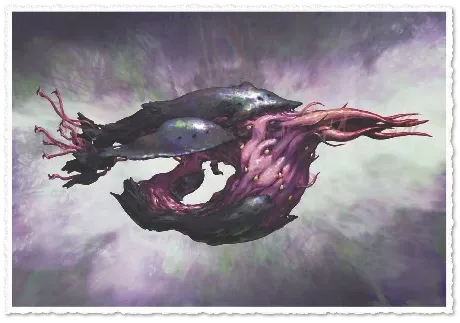
It had not moved. It had not stepped out of the fog. It was simply present, where a moment before there had been only grey air, as though the fog had condensed into something solid and awful. It stood the height of a man and it was shaped wrong, shaped like a man drawn from memory by something that had never seen one. Its head was a mass of pinkish pulp, wet and ridged like a brain left outside the skull, and the colours rippling across it were the same colours that rippled across the crystals in Jeffrey’s head — the same pulse, the same sequence, in perfect synchrony. Below the head, two dark-red claws the size of a man’s torso, chitinous, jointed like a lobster’s. And behind, folded and then unfolding, wings — membranous, translucent, veined, catching the colours from the head and refracting them.
It had no face. It was a mass, pulping softly, sifting colours on a pad of wet flesh. And although it had no eyes, every one of them felt, with a certainty that bypassed reason and landed in the base of the skull, that it was looking at them.
It reached down with one great claw. It took the head — John Jeffrey’s head, what was left of him — as gently as a man lifts a child. And then its wings spread, and the buzzing roared up into a frequency that shook the teeth, and the thing rose into the fog and was gone.
The crystals went dark. The clicking faded. The camp was very quiet.
And then, from the tents, Clarissa Thurber screamed once — a short, cut-off sound, like a wire snapping — and did not scream again.
What Came Down
What happened next happened very fast, and in the fog, and none of them ever agreed afterwards on the order of it.
Mauricio was frozen. The buzzing had synchronised with something inside him — his heartbeat, his breathing, some rhythm he had not known he possessed — and his legs would not carry him and his arms would not lift. He stood beside the dead fire pit with the colours still printing themselves on the inside of his eyelids and he could not move, and the thing that had taken the head was already gone but there were others, he could hear them, the clicking and the buzzing and the soft heavy impact of something large settling onto the earth, and from the tents came sounds that were not quite screams and not quite silence but the place where one becomes the other.
Clement ran for the truck.
He had the Luger out. He had carried the head for two days and now the head was gone and the night had turned into the kind of night he had walked through once before, in a valley in the Alps, when something without a face had come down out of the rocks. He reached the truck, wrenched open the door, turned the key.
Nothing. The engine didn’t start up. He tried again. Nothing. Something was wrong with it. He dropped from the cab approached the fire pit and raised the Luger toward the shapes moving in the fog.
He fired. The shot struck home. He heard the wet, pulpy impact — a sound like a fist driven into wet clay — and the thing in the fog reeled. But it did not fall. It turned toward him, the colours on its head deepening, and the buzzing rose, and Clement understood with the calm, dispassionate clarity of a man who had survived forty years of mountains and one war that a bullet was not going to stop this. The Luger’s round had passed through the thing’s body with minimum effect, as though it were not quite solid, as though the bullet had struck something that only mostly existed.
He fired twice more. One shot went wide. One struck. The thing recoiled, then pressed forward. It was not fast. It did not need to be. It moved the way fungus grows in a time-lapse photograph — deliberate, inevitable, in a direction that seemed to have nothing to do with the arrangement of its limbs.
Nari came out of her tent.
She was awake when she heard the sound of Clarissa’s cut-off scream and known, with the immediate animal certainty of a woman who had survived a tiger, that whatever had come into the camp had come for someone and that someone might be her. She had grabbed for a stick from the fire pit, torn a strip of cloth from her skirt, soaked it in the dregs of Blaine’s moonshine — but her left hand, the hand with the prosthetic fingers, the hand that had been a tiger’s lesson when she was nine, betrayed her. The bottle slipped. The alcohol splashed across her sleeve. The cloth caught. Her sleeve caught. She was burning.
She threw the torch. It missed the creatures entirely — they were at the tents now, cutting the canvas with their claws as quietly as scissors cut paper, reaching in — and it landed on the tent where Block and Gibbons slept, and the canvas went up.
Nari tore the burning sleeve from her arm and ran.
Clement saw her go. He saw the tents burning. He saw the shapes at the tents lifting bodies — Block’s big frame, Gibbons’s lanky one — rising into the fog with a single claw under each ribcage, as easily as a man lifts a coat from a peg. He could not stop them. The Luger had four rounds left and the things did not fall.
Run, Joe Harlow was shouting, from somewhere in the fog. Just run. And then, quieter, to himself, or to the dark: Those are the things from my dream.
Clement emptied three shots into the nearest shape — one struck, two missed — and the thing turned its full attention on him, and the buzzing climbed into a frequency he felt behind his eyes, and something was forming in the drone, something that was almost words, and he felt his will begin to bend. He threw himself sideways, down the slope, rolling the way he had rolled forty years ago in a valley full of smoke, the sausage-roll of a man trained to get out from under something that wanted to crush him, and the green mist — the thing had produced something, a weapon, organic, pulsing, that spat a cloud of sweet-smelling spores — the mist passed over the space where he had been standing and dispersed.
He scrambled to his feet and ran, downhill, into the fog, into whatever was left of the night.
What Mauricio Said Yes To
Mauricio did not run.
He could not. The buzzing held him where he stood, and the thing that had come for the head was back, or another one like it, and it was close, and the colours on its head were shifting in the same rhythm as the heartbeat he could no longer feel as his own. And out of the drone, words formed. Not English. Not any language. A pattern of vibration that resonated in the bones of his skull and resolved, somehow, into meaning.
You will come with us. You will not be harmed.
His lips moved. He asked what they would do with him. The buzzing shifted.
We can offer you eternal life.
Mauricio Duarte was twenty years old. He had grown up in a mining family and watched his uncle die in a tunnel and crossed an ocean to get away from the dark. And the dark had followed him here, to a hill in Vermont, and it was speaking to him in a language of pure sound, and it was offering him something that no professor at Miskatonic could offer, and the fear was so large in him that it had circled back around to something that felt, from the inside, like calm.
He thought of John Jeffrey. The head. The crystals. Whatever had been done to Jeffrey had been done by these things, or things like them, and Jeffrey had been alive — alive in the worst way, but alive — and Mauricio wanted to understand. He had always wanted to understand. That was why he had come.
I’ll come, he said.
The thing produced its weapon. The green mist rolled over him. It smelled of overripe fruit and mushrooms in a damp cellar and the ozone taste of a thunderstorm, and the world folded inward, and Mauricio Duarte was gone.
The Rabbit and the Roof
Three miles away, at the Maclearan farmhouse, Robert Blaine was cooking rabbit.
He had arrived in the only working car just before dark, cheerful and magnanimous, asking after the interviews, full of professional interest in everything Father Cloutier and Susan had gathered. He had a big pot of it — rabbit with potatoes — and he served it out generously and sat at the table eating with Noakes, who used his hands, and Laslow, who ate nothing and sat in the armchair in the front room. The fog was pressing against the windows. Blaine did not seem to notice it.
Father Cloutier and Susan had already eaten at the diner in town and were not hungry. Susan, in fact, had taken Jason Trent upstairs — the boy was pale, trembling, claiming a weak heart — and when she came back down she pulled Father Cloutier aside and spoke quickly, in a voice she did not want Blaine to hear.
*Don’t eat this thing. This man is wrong. He wants to poison us. The students died last year. They were with him.’
The priest looked at her. He looked at the pot. He looked at Blaine, who was eating the rabbit himself, calmly, with every appearance of relish.
Blaine excused himself after the meal. He needed the outhouse, he said. He stepped out into the fog, and for a long moment the house was quiet, and then something heavy landed on the roof.
The sound was wrong. Not the scrabble of a cat, not the creak of a settling beam. A single, heavy impact, as though something the size of a man had dropped from a height and landed on the slats above their heads. And then a sharp crack — louder than a branch, a splitting.
Blaine came back in. His face was composed. Probably a cat, he said. He looked at Noakes. Go on up, would you? You’re the handy man. Give me a hand.
Noakes went. He climbed the built-in ladder at the edge of the house, the one used for getting onto the roof, and Blaine held the base of it, and Father Cloutier went upstairs to check the ceilings. The fog was so thick now that visibility from the ground was no more than two or three metres. Father Cloutier could not see the roof from the upper windows.
They waited. Thirty seconds. A minute.
And then Noakes screamed.
It was short. It was cut off. And then it was getting further away — not fading, not diminishing, but rising, as though the voice were being carried upward — and then it stopped, and in the silence that followed, Father Cloutier heard a sound he would not be able to name for the rest of his life: a wet buzzing, like the sound of an insect heard through water, muffled and enormous.
The Green Mist
Blaine ran inside shouting for everyone to stay put. Father Cloutier came down the stairs. From outside, around the whole house, the clicking began — wet, rhythmic, the sound of too many hard things moving in sequence — and the buzzing settled over the building like a second roof.
Then Blaine opened the door and called out into the fog. Noakes slipped! Give me a hand! And Higgins and Laslow, who had been frozen in the front room, ran out after him, and the fog took them.
Father Cloutier went up the ladder.
On the roof, the fog parted for half a second, and in that half-second he saw a claw — dark red, chitinous, the size of a man’s torso — and then legs, many legs, not human legs, jointed wrong, and then a wing, membranous and veined and translucent, catching a light from somewhere he could not identify, and the fog closed again. He could not find Noakes. There was nothing on the roof but the fog and the sound.
He climbed down.
From below, from the yard where Higgins and Laslow had gone, he heard Higgins’s voice — What is that? What is that thing? — and then a sound like air escaping from a water gun, a hiss of displaced atmosphere, and then the sound of a leather belt stretched to breaking, a thick wet snap, and then the beating of membranous wings, and Higgins did not speak again.
Susan opened the back door a crack. Through the gap she saw Laslow standing in the fog, and his eyes were wrong — wide, bulging, fixed on something she could not see — and then he was not there. He did not fall. He did not run. He was simply absent, and the air where he had been was churned with the downdraught of wings.
Three of the things were visible now, moving out of the fog toward the house. They moved in perfect synchrony, their colours shifting in unison — green to pink to purple to red — their brain-like heads pulsing in the same rhythm, and although none of them had eyes, Susan felt the weight of their attention settle on her like a hand.
She slammed the door. She screamed at Father Cloutier to get inside, to lock himself in, to run.
The priest turned to face the things in the yard. He had his staff, his cross, forty years of prayer and the absolute conviction that the world contained more than the catechism accounted for. He had stood at a thousand deathbeds. He had held the hands of the dying and the damned. He had seen Clement’s head in a back room and had not looked away.
A claw took him across the chest.
He went down. The ground met the back of his skull. And above him, leaning close, one of the things produced its weapon — that organic, pulsing thing, egg-shaped, pinkish-green, sprouting thin tube-like tendrils — and a cloud of green mist rolled down over his face, and the last thing Father Ludovick Cloutier knew was the smell of overripe fruit and the hum of a language made entirely of vowels, and then there was nothing at all.
Susan went out the kitchen door and ran.
She ran through the fog, away from the farmhouse, away from the sugar maples, toward the road, toward the town. She could hear nothing behind her but the silence that follows the buzzing, which was worse than the buzzing itself. She reached the first houses of Cobb’s Corners and did not stop. She ran to the Gazette office and hammered on the door until Richard Wendell, in his pyjamas, unchained it and let her in, and she told him everything — all of it, in a single breathless flood, the things in the fog and the claws and the green mist and the friends who were gone — and the editor of a small-town newspaper sat down at his desk and took out a notepad and wrote it all down, because that was the only thing he knew how to do.
The Dead Telephone
Clement, Nari, and Joe Harlow came down the hill in the dark.
Nari’s hand was burned. Joe was weeping. Clement had four rounds left in the Luger and the taste of his own blood in his mouth, where he had bitten through his lip during the roll down the slope. They did not speak. They moved by instinct and by the slope of the ground, downhill, toward the lights of the town, and the fog thinned as they descended, and by the time they reached the first houses of Cobb’s Corners nothing was following them anymore.
They were half-walking, half-staggering — three figures out of a nightmare, scorched and battered and reeking of woodsmoke and moonshine — when the sheriff’s car found them. Deputy Cutter stepped out, calm and steady in the way that Deputy Cutter was always calm and steady, and asked what had happened.
They told him. They told him in overlapping fragments, the words tumbling over each other: the things in the fog, the claws, the buzzing, Clarissa taken, Block taken, Mauricio gone, the truck dead. Cutter listened to all of it with the patient expression of a man hearing a story he had already been told, and then he put them in the car and drove them to the sheriff’s office.
Sheriff Dan Spencer was behind his desk. He listened to the same story with less patience. He smelled the air. He looked at Joe Harlow, who could barely stand, and at Clement, who still carried the sharp tang of the moonshine he had not drunk but which had splashed across Nari and the camp, and at Nari, whose sleeve was charred and whose three-fingered hand was shaking.
Drunk, Spencer said. All of you.
Clement protested. He invoked his name, his reputation, his position with Federated Oil and Chemical. He threatened to report Spencer to the county sheriff’s office. Spencer was unmoved. Cutter went out, he said, to check on the farmhouse. When he came back, he was carrying two empty bottles of moonshine, and he had a story of his own: he had spoken to Blaine, and Blaine had told him the students had been drinking, that things had got out of hand, that they had wandered off into the woods in the fog.
Spencer dialled the farmhouse. Dead. Probably rodents chewed the wires, he said.
They were put in the cells.
Jimmy Maclearan was already there — Sarah’s husband, still sobering up from the business with the bones, roused by the commotion and watching the newcomers from behind his own bars with the bloodshot, uncomprehending stare of a man who had his own grief and no room for anyone else’s. The cells were clean. The doors locked. The building was brick, with barred windows. It was, Spencer said, the safest place in Cobb’s Corners, and he might have been right.
Clement still had the Luger. They had not searched him. Four rounds. He sat on the cot in his cell with his coat buttoned and his hand on the grip and his eyes on the door, and he did not sleep.
Nari did not sleep either. Her hand was blistered and raw. She could hear, or thought she could hear — or had invented, in the silence, the memory of — a low drone, felt more than heard, coming up through the concrete floor of the cell, as though the earth beneath the sheriff’s office remembered what the earth on the hill remembered.
Across town, at the Gazette, Susan Chen sat on the editor’s couch with a blanket around her shoulders and listened to Richard Wendell’s pencil scratching across his notepad, and did not sleep, and waited for a morning she no longer believed would help.
What Came Back
Morning came.
Professor Roger Harrold arrived at the sheriff’s office at half past eight, unshaved, rumpled, still in the clothes he had driven through the night in. Nari’s call to her father had reached him. He had come as fast as a car could carry him, and what he found, when he got here, was his expedition in a jail.
Spencer gave him the story: the students had been drinking, the moonshine had flowed freely, they had wandered off into the woods in the fog, and now they were making wild accusations to cover their own recklessness. The empty bottles were on the desk. Cutter confirmed it.
Harrold stood at the cells and looked at Clement and Nari, and his face had the particular exhaustion of a man whose guilt over the first expedition was being compounded, in real time, by a second. He told Nari there would be consequences. He told Clement that his association with Miskatonic was at an end. Clement, who did not work for Miskatonic and never had — he worked for Federated Oil and Chemical — did not bother to correct him. It did not matter. What mattered was that no one was going to the hill. What mattered was that the people who had been taken were still out there, or up there, or wherever the things had carried them, and the sheriff was polishing his glasses and the deputy was smiling his tight, small smile and nothing, nothing at all, was being done.
And then the door opened.
They came in one by one. Blaine first, composed and concerned. And behind him, walking under their own power, eyes open, voices steady — Clarissa Thurber. Roderick Block. Louis Gibbons. And Mauricio.
And behind them, the others from the farmhouse: Noakes, Trent, Laslow, and Father Cloutier, the priest upright and whole and moving with a care that might have been the soreness of a man who had been knocked down the night before and might have been something else.
They were alive. They were unhurt. They stood in the sheriff’s office in a loose cluster and answered Harrold’s questions in voices that carried no urgency and no fear. Yes, they had been drinking. Yes, it had got out of hand. Joe Harlow had been pouring moonshine for everyone. They had wandered off. The fog had confused them. They had slept it off in the woods. It would not happen again.
Mauricio, who had talked without stopping since the day he arrived at Miskatonic, who had laughed too loud and asked too many questions and could not sit still for five minutes — Mauricio said only, We pushed it a bit, and smiled a small, closed smile that did not reach his eyes, and said nothing else.
Nari stared at them. She looked at Clarissa’s face and at Block’s hands and at Mauricio’s smile, and something in the arrangement of their features — the smoothness of their expressions, the synchronization of their movements, the way they all turned to look at Blaine at the same moment, as though listening for a signal — turned her stomach to water.
Clement, still in his cell, still with the Luger under his coat, watched Father Cloutier’s face. The priest he had shown the head to, the priest who had crossed himself and had not looked away, who had prayed in Hindi and Latin and the private language of a man who believed the world was more than it appeared — that priest was standing in the sheriff’s office with the bruises of the night hidden under his collar and his eyes were flat and calm and did not recognise the Swiss man watching him through the bars.
The sheriff was satisfied. Harrold was mortified. The matter was closed. The expedition was over. They would pack up. They would go home. Whatever had happened on the hill was a student prank, a drunken episode, a failure of supervision. The bodies that had been carried up into the fog had walked back down on their own two feet, and they said so themselves, and who would believe otherwise?
Harrold went to make arrangements. Spencer went back to his paperwork. Cutter, at the door, watched the students file out with the expression of a man who has finished a task and is pleased with the work.
Clement Scheidegger, fifty-two years old, sat in a cell in a Vermont sheriff’s office and watched his friend walk out the door in a body that moved like his friend and spoke with his friend’s voice and was not, in any way that he could name or prove or explain to anyone who had not been on the hill last night, his friend at all.
Nari was released. She came to the bars. Her burned hand was wrapped in a rag. She did not cry. She looked at Clement the way a person looks at the last solid thing in a room where the floor is dissolving.
He reached through the bars and took her good hand and held it, and he leaned close, and in a voice low enough that only she could hear it, in the steady, precise tone of a man who had survived the Alps and a war and a valley in the hills where the dead were crowned on rocks, he said:
Courage, my girl. We will make it. Don’t trust anyone. Trust no one.
Outside, the fog had lifted. The sun was on the valley. The birds, which had been absent from the hill, were singing in the town as though nothing had changed. On Broken Hill, the tents stood empty and the fire was cold and the truck sat in the scrub, and the mass grave at the foot of the slope lay open to the morning light, and the bones glinted, and the ground hummed, and no one was listening.
Next: The head is gone. The buzzing has stopped. The silence is worse.