

Protagonists
- Clement Scheidegger - FOC Representative, Mountaineer (Michalis)
- Narinder “Nari” Sodhi - Natural Sciences Student (Ioannis)
- Sofia Picado - Chemistry Student (Istvan)
- Susan Chen - History Student (Konstantina)
- Lillian Neill - Anthropology Lecturer (Tasos)
The Ninth Planet
“You are lying. This solar system only has eight planets.”
— Dr. Sarah Matherson, to the company’s captive — from a phonograph record made November 18th, 1926
Summary
- The fifth floor, Detroit — Guests of Federated Oil and Chemical: wardrobes already filled with clothes cut exactly to their measures, windows screwed shut behind steel screens, a guard at the private elevator, and no step outside without escort — Mr. Abelard receives threats, and the enemy has wings. Letters home are posted by Miss Preston’s own hand.
- The library — They meet Professor David Drake, historian and psychologist, who interviews each of them about Vermont and offers his care. Nari spends days in his rooms; Clement is told that the easy thing is to climb a peak, and the hard thing is to come down.
- The conference room — The expedition team is presented: Dr. Sarah Matherson, Captain Sam Morrison, and Larry Nekler. Over lunch the investigators tell the company everything, and the company answers in kind — what blades and fire do to the enemy, the film that shows an empty chair, the reporter Wendell’s impossible photograph — and lays out the plan: a small team back at the Maclearan farmhouse, soldiers hidden in the forest five minutes away, radio contact three times a day, a geological survey for a cover story. To the equipment list the guests add flamethrowers.
- The basement — Behind curtains: a steel table with restraints, mummified bodies from an abandoned base in the Andes being dissected — a kind of the enemy built, they believe, to pass as men — and a green-black tablet carved with a winged thing whose head is all feelers. In the office beyond, a phonograph plays the interrogation of the only captive ever taken alive: English learned in two days, a demand to return to the mountain, the words Yuggoth — the ninth planet of this system — and the creature dying mid-answer, rotting brown in minutes. Pluto, Matherson notes, was found only this year.
- Recuperation — The days run together gently: books, the company range, Drake’s consulting room. Nari, kept upstairs by Drake’s order, is given a pencil rubbing of every glyph on the stone.
- The telegram — Abelard, over a wire from Canada: two bodies at La Tuque, a mill town in the Quebec hill forests — skulls opened, brains gone. While Morrison sources the flamethrowers, the company asks its guests to go and look.
- North — A company plane to Quebec, first class on the Canadian National, and the lawyer Nicolas Thibault waiting on the platform with a sign reading FOC and an envelope of five hundred Canadian dollars. La Tuque at last: wide streets, mill smoke on the Saint-Maurice, woods pressing in on every side — and a smell of sulfur that no one in town seems to notice.
Windows That Do Not Open
From the street, the building might have been a bank. Inside, the lower floors very nearly were one — accountants, secretaries, vice-presidents, the ordinary machinery of Federated Oil and Chemical — and above all that, reached by a single private elevator with a guard posted day and night, lay the fifth floor where the guests were kept.
The wardrobes were the first thing. Each room’s stood open and full: new clothes, good clothes, cut exactly to the measure of the person sleeping beside them. In Nari’s hung saris — red and gold, trimmed with lace — the exact size, as though the company had run a tape over her in her sleep. Even the notepaper on the little desk was expensive.
The windows were the second. Every one on the upper floors was screwed shut behind metal screens; the glass let in light and nothing else.
Susan asked it plainly, first thing: could they go out? With an escort, Miss Preston said pleasantly — and the company would prefer to avoid that. Mr. Abelard received threats. Competitors. And the others — which flew, she added, in the tone of a woman confirming the weather. Susan knew the name Preston, come to think of it: New York money, a society family, all of it gone in a night the autumn before. The daughter now ran the fifth floor of an oil company in Detroit, and never once mentioned it.
Clement stood at his screened window like a man watching his train leave without him. “I am used to open air. On the summits there is nothing else to breathe.”
“The air here is filtered,” said Preston. “The best machines made. Do not concern yourself.” And, at the door: “Settle into your rooms. Whatever you need, I am in 507 — knock whenever you like.”
Letters home were handed to her to post. Nari asked for artists’ pencils and good paper; of course, said Preston, we will arrange it — and by evening it was arranged.
That was the shape of the hospitality. Nothing asked for, everything provided, and nothing at all chosen.
The Man with the Pipe
Clement was first into the library. A heavyset man sat at the long table with a book open before him — bald at the crown, the rest of his dark hair going grey, a handlebar moustache, a brown suit, and a long-stemmed pipe whose smoke he studied as if reading it. He looked up exactly as long as a man looks up who has been waiting.
“Professor David Drake. Historian first — and after that a psychologist, which is the harder discipline. I know you from Miss Preston and from Mr. Abelard. You are the group going back.” He closed the book. “Sit down and tell me everything. And when I say everything, I should especially like to know how it felt.”
He wrote in a notebook and turned his shoulder while he wrote. When Lillian wondered aloud how modern his methods were — whether the treatment ended in anything sharp — Drake winced around the pipestem. “Those are outdated things, I promise you. We solve problems with words. Talk to me.”
So they talked. Nari gave it to him flat, the way she had learned to: “Things are more serious than you believe.”
“Then you are in the right building.”
Over the days that followed, the library became a consulting room. Nari took the chair by his desk for an hour each morning; he watched her quietly for half of one, and then said, gently, that whatever else she had survived, it was her father who sat behind her eyes, and that this too could be spoken of. Clement came the way mountaineers come to doctors — late, and as a courtesy to others — and spoke of home in the careful way of men unused to being listened to. Drake let the pipe go out, and at the end gave him back a single sentence.
“Sometimes, Mr. Clement, we do not need to run so far from our problems. We must face them. The easy thing is to take your Alps and climb a peak. The difficult thing is to come down again and live an ordinary life.”
Clement took that away with him, and did not answer it, and did not forget it.
Tell Us Everything
Lunch was carried into conference room 508 on trays: cutlets wearing little white paper frills on the bone, china, silver coffee pots. Susan asked whether they had milk. Of course, miss.
The team was presented. Dr. Sarah Matherson was small and owlish behind bottle-thick glasses, a mug of black coffee never far from her hand; there was Saulteaux blood in her, she mentioned, unprompted, apropos of nothing, and a chair until recently at the University of British Columbia — “until Mr. Abelard showed me a jar. I have not been back. I do not miss it.” Beside her sat Sam Morrison, big and crew-cut, shrapnel scars at his throat and wrists — the Argonne, someone said — with a single sentence by way of credentials: “Mr. Abelard has given me permission to capture or kill any of them.” And Larry Nekler, stocky, nose broken and set wrong, a merchant sailor’s forearms: “I keep the radio. Morning, afternoon, night. As long as that schedule holds, somebody sane knows where you are.”
Then Murdoch wheeled Abelard in, and the room went quiet the way rooms did.
“Tell us everything.”
They told everything. Clement gave it like a report — the dig, the hill, the jar that had spoken, the guns, the fire — and the others filled in what he had not seen: the dynamite, the children’s drawings, the classmates who had come back wrong and had to be put down. The company took notes; Matherson interrupted with questions that were all anatomy. Pasqualle had already been through the Arkham library’s ruins, Abelard said, making a list of the books the raiders had wanted; everything connected, and the company meant to have all of it.
Then the company answered.
“Bullets annoy them,” Matherson said. “Cut one, and the rot starts at the blade — minutes, and brown, and gone. Fire is better. Fire is final.” They had filmed their captive once, she added; the prints went round the table and showed a cell, a chair, the straps — and the chair empty. “The film shows me talking to nothing at all.”
They told her about the newspaperman, Wendell, who had caught one by accident on some new kind of plate. Matherson put her coffee down for the first time in the meeting. “Find how he did it, and we will hang cameras on every mountain on this Earth.”
The plan came last. Back to the Maclearan farmhouse — a small team, quiet, the story for the village a geological survey continuing the university’s work, the house already paid for again. Nekler at the radio three times a day. Morrison’s alarms and traps ringing the farm — “nothing crosses that ground that we do not hear” — and a company of ex-soldiers leased into the forest nearby. “Five minutes,” said Abelard. “The trick is that they are not noticed. That, we must arrange.” An equipment list went round, with room left for additions. They added flamethrowers, fatigues, and dynamite. “The flamethrowers are not easy to come by,” Abelard said, “but fortunately, we have the means.”
Sofia asked the last question of the afternoon — whether the men who served the creatures might keep some piece of themselves; whether they might even be turned. The room considered it.
“They were not the creatures,” Drake said at last. “They were men. Why they followed, we don’t know.” And the brains, someone added quietly, go into other bodies — there had been a list of true names, and Harold’s dying words — I waited a year for this — and among the names of the dead a student who had vanished on the first expedition, whose name had no business on anyone’s list but the enemy’s. The company wrote that down too.
Below
The invitation came from Matherson, for those with the stomach for it. Drake asked Nari, at the elevator, to stay above; she spent the hour with Sofia, and had it all back later, twice — once from the telling, and once on paper.
The basement was bright and clean and smelled of mold and chlorine. White coats in a lobby, a circular sink, two doors. The laboratory ran long and low, and down its length stood the cells — steel frames behind heavy curtains.
The first curtain stood half open: a steel table, leather restraints, a generator on the floor beside it with its leads coiled.
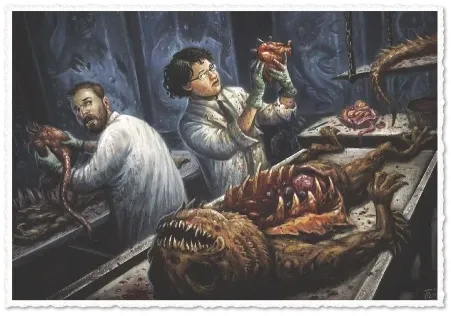
The second: two scientists bent over dead things. Mummified — man-high, two-armed, two-legged, their features dried past reading — brought out of a base in the Andes that the company had found abandoned. One of the scientists was lifting dried organs clear with forceps, gently, like a jeweler clearing a movement. Behind them, in a glass tank of water, more of the same were steeping, being given back their moisture a little at a time. “A kind we had not met,” Matherson said. “Built, we believe, to pass as men.” She reached past the watchers and drew the curtain shut.
The third cell was a museum: hunting spears, knives of black glass, gold worked in patterns no goldsmith would recognize — and, alone on a stand under the light, a tablet of greenish-black stone. Not of this Earth, the geologists had concluded — the stone itself. Rows of script no living language accounted for; and at its center, carved deep, a hunched figure with wings half spread, claws resting on its knees, and for a head a mass of feelers, exuding an air of brooding malice. The country’s best cryptographers were being assembled to read it.
At the workbench in the corner, under a lamp, in pieces, stood the black gun with no trigger that had been taken from Clement at the dock, a scientist busy inside it. Nobody had said anything about returning it.
Then the office, and the phonograph.
“Recorded on the eighteenth of November, 1926,” Matherson said, and lowered the needle. “The only one of them ever taken alive. It had been with us two days.”
A voice like machinery arguing with itself.
“You have been here two days. Why did you wait until now to speak to me?”
“I did not speak your language.”
“You mean that you learned English in two days?”
Static, pure and long. Then: “Why do you wish to speak to me now?”
“Hungry. Cannot consume food. Must return to mountain. No harm. Need food. Will die.”
“I warn you — if you do not answer my questions, I will be forced to administer an electric shock, to make you talk.”
Three minutes of it then went onto the wax: the hum of current, static, metal scraping, a woman’s voice shouting — and over it all a buzzing scream with nothing human in it anywhere. When the words came back they were almost past understanding.
“Yuggoth. The ninth planet of this system.”
“You are lying. This solar system only has eight planets.”
The current again. The question again — what is your reason for being here — and the answer was no answer: an ear-splitting wail, a full minute of silence, and then the buzzing, saying the same thing three times over.
Iä! Shub-Niggurath! The Black Goat of the Woods with a Thousand Young!
Then nothing. Then Matherson’s own voice, younger on the wax, flat as a ledger: “It appears the subject has died. Its head is no longer changing color, and decomposition is rapid — the body discoloring to brown. Putrefying. End the recording. I must rush the carcass to the laboratory and begin the autopsy before it is too late.”
The needle lifted. In the little office, no one had moved.
“The ninth planet,” Matherson said into the silence. “Our astronomers found it only this year. They are calling it Pluto.” Her great eyes shone behind the bottle glass. “It did not lie about that. We must learn. We must learn.”
From a drawer she brought a photograph: a door carved from the living rock of the Himalayas — the same architecture, curve for curve, as the door Clement had described in the hills above Cobb’s Corners. If the doors were doors, then the mountains of the world had been speaking to one another for a long time.
Upstairs, the rubbing of the tablet was pressed into Nari’s hands — pencil on paper, every glyph. She took it to her room, and was a long time coming down.
The Smell of Sulfur
The days ran together after that, and gently — which, in that building, was its own warning. Lillian worked through the library’s shelves of field guides and survival manuals. Hours were burned on the company range under Morrison’s eye. Miss Preston came by with things they thought of before they thought of them. The windows stayed shut. Somewhere below, the plants worked on.
Then, on a morning with a new sound in the corridors — heels, and quickly — they were called to 508. Abelard sat over a telegram as though it had been sent to him personally. Two bodies, in Canada. A small city called La Tuque, in the hill forests of Quebec: a pulp-mill town on the Saint-Maurice. The tops of the skulls removed. The brains gone.
“You have seen this work before,” Abelard said. It was not quite a question. “While Captain Morrison finds your flamethrowers — and it is taking some finding — show me what you can do.”
There was a company man in Quebec, a lawyer; everything would be arranged. Matherson was staying with her mummies. So it was the five of them — a company plane out of Detroit, down at the aérodrome above Quebec City, a taxi ordered by unseen hands to the Gare du Palais, and the Canadian National Railway north, first class, three hours into a country of lakes and cut forest.
Nicolas Thibault was waiting on the platform at La Tuque with a small sign reading FOC — a small, fair man in a good coat, precise as a watch. “Bienvenue à vous.” He handed over an envelope of five hundred Canadian dollars and a receipt to sign, and answered most questions with the name of the person who could answer it better.
The town, from the platform: wide streets, grass to the curbs, the Canadian flag hanging on shopfront after shopfront; paper mills smoking along the wide river; and beyond the last back streets, woods — hills upon hills of them, green right down to the fences. A town built where a trading post had stood, French in most mouths, its living made by cooking the forest into paper.
And under everything, before they were even off the platform, the smell. Sulfur — faint, chemical, wrong, like a match struck in a sickroom. The whole town was breathing it. Nobody in the town was noticing.
“It is the mills,” Thibault said. “Sulfur and water, cooked, to soften the wood pulp. You will get used to it.” He tossed his little sign into the wastepaper basket. “Everyone does.”
Next: La Tuque — a town of closed French doors and woods that press the streets. Two men died here with their skulls opened. The company believes it knows what did it. The company may be wrong.