

Protagonists
- Clement Scheidegger - FOC Representative, Mountaineer (Michalis)
- Narinder “Nari” Sodhi - Natural Sciences Student (Ioannis)
- Sofia Picado - Chemistry Student (Istvan)
- Susan Chen - History Student (Konstantina)
- Lillian Neill - Anthropology Lecturer (Tasos)
“You need a scapegoat. Here I am.”
— Clement Scheidegger, to Detective Harden
Summary
- The Arkham cells, night of September 12th — Booked in around one in the morning with a city’s worth of the maddened; everything they carried confiscated, and Nari loses most of her sketchbook fighting four officers for it. At five the poison releases the whole block, and three hundred memories come back at once — Dean Bricknell’s among them. Lillian, brought in at two, is sobered, released, and gone by morning.
- Harden’s office, September 13th — Interrogated one by one: arson, manslaughter, explosives, trespass, larceny of a motor vehicle, public indecency. Amnesia, a conspiracy of the dead, and one mistaken-identity joke are the whole defence. Mid-morning a whisper at the door: a body in a Science Hall closet, burned past questioning, identified by a golden wristwatch.
- The confession — In the cells they agree the students cannot hang for this, and Clement takes all of it — the entire impossible truth, told to Harden as a scapegoat’s gift, with an offer to bring in an alienist to certify he believes it. The detective turns suddenly polite. When Wilmarth visits that afternoon, Clement whispers the plan to him and then frightens him off through the bars.
- The night — Nari sketches her father with a monkey’s head and sleeps the quietest sleep she has had since Cobb’s Corners; Sofia counts her dead; Nari resolves to build a society against the possessed.
- Release, September 14th — At nine their belongings come back in a cardboard box — the sketchbook in two pieces, the Tommy gun kept as evidence. Outside, Harden is shaking hands with a lawyer, Leon Pasqualle — brother to the Victor Pasqualle who walked into the Vermont hills and never walked out — who has already paid for the Excelsior, new clothes, and the quiet dropping of every charge.
- Breakfast — Over a diner table bought by Federated Oil and Chemical: the library, the dormitories, and the science hall will all be rebuilt; three expulsion letters signed by Bricknell redefine hospitality; Boston Harbor, ten o’clock tomorrow. Asked whether the things have wings, Pasqualle answers, Yes. Multiple appendages — and shares nothing else.
- Loose ends — Sofia presses Harden (we all get orders from above) and leaves him a name to start with if anything happens to them; Nari and Lillian receive Armitage’s gratitude — the Restricted Collection survived — and his refusal; a black Cadillac watches the Aylesbury Street warehouse with two patient men in suits.
- Westward, September 15th — A prototype seaplane off Boston Harbor — the dog came too, and wagged at exactly the wrong man — then a private dock beneath three smoking plants on the Detroit River, a kilted giant to collect the weapons, and Michael Abelard in a silver Rolls: no legs, one dead son, eight years of hunting, and a name for the enemy. The fifth floor. Guests.
Five O’Clock in the Cells
They were booked in a little after one in the morning, into a station already drowning. The cells held the city’s harvest of the evening — men in dinner jackets, boys in nothing at all, a lecturer somewhere down the row saying her one word over and over — and the duty sergeant, fingerprinting four more, no longer bothered to pretend he knew what crime any of this was.
Everything went into a cardboard box. The Luger. The .45 that could be traced to O’Bannion’s crew. The violin case with the dark stain dried at its edge. The black oblong thing with no trigger. Nari got both arms around her sketchbook and lost it anyway — four of them pulling — and they let her keep a torn corner with an inch of green crayon on it. She sat down holding that, and said nothing.
At five o’clock the mood of the block turned like weather. The poison wore off and the shouting thinned into small, appalled voices. These were not people waking from nothing; they remembered. Shame moved down the row of cells like a cold draft, and in the next cell Dean Marinus Bricknell — sober since five, dressed in an enormous borrowed pair of underdrawers — sat very straight on the bench and looked at no one.
Lillian had been brought in around two, still laughing, still saying her word, and had laid hands on an officer in a way the report did not describe precisely. By morning she was sober, shattered, and free — the only one of them the police could look at without a charge list in mind.
At seven, they were taken up one at a time.
The Detective’s List
Detective Harden had a small office, a small cigar, and the patience of a man who already knows the file is airtight.
Clement went first. Arson in the second degree. Trespass on ground the President himself had barred him from. Concealed weapons — and a revolver the department could tie to the O’Bannion gang, which was an interesting friend for a company man to keep. Harden remembered his face from the night Blaine died, too. Clement folded his hands, asked for his solicitor, then for a telephone, and — reading upside down while the detective made notes — glimpsed the single word Harden had written on his pad: guilty.
Sofia’s file was the fat one. Manslaughter; unlawful possession of explosives; a concealed weapon. She wept, and beautifully. She remembered nothing; she was a good student, a chemistry student, with good grades. Told of her dead, she tried the other door: the wrong girl, surely — there were two of them that night, and everyone always confused them. When that failed, she stopped weeping altogether.
They were not innocent. There was a raid — ask the guards, they went in first. I defended Arkham. I did your job.
So you appointed yourself executioner, with a Thompson gun.
I’m a natural talent.
Nari played it exactly as she had played it on the lawn. Embarrassment; infection; nothing. She had run naked, Detective — and she had not been the only one, at least, which was the only excuse she had. A dog had protected her, and a filthy professor had killed him. Her own father had been on a car roof doing — she could not say it. Her defence ran on to magic she had seen in India, things done to the food, a whole campus taken; Harden heard her out and gave her the only advice he gave anyone that morning. Don’t tell a judge those things. You’ll get the asylum instead of the jail — and it won’t be easier.
Twice during the women’s hours a uniform came to the door and whispered. The second time, Harden laid it flat on the table like a card: a body in a closet under the Science Hall. Burned. What the fire had left of the skull was broken, and the identification rested on a golden wristwatch Professor Learmonth had always worn. Perhaps you know something about that.
The answer did not change. They had been watching the raiders; ask Professor Armitage; that was why the guards had been doubled. Harden wrote something down, and did not believe any of it, and the morning went on.
The Scapegoat
Comparing notes through the bars, they did the arithmetic. Witnesses had seen everything that could be seen. Whatever story they told, the students among them hanged — unless the case closed around a single head.
Then take mine, said Clement. I’ll tell them I did everything. I’ll tell them the whole truth, every detail — the hill, the head that talked, the creatures. Not one word of it will be believed. Let them bring an alienist; he can certify that I believe it, because I do.
Susan, who had spent the night watching witnesses scream her friends’ names, put it more coldly: the police would want the case closed without a trial full of Miskatonic students. Give them the foreigner who wasn’t enrolled — the Austrian.
Swiss, said Clement.
Sofia gripped the bars between the cells. The asylum is easier than prison. We’ll get you out. And Clement, after a moment: he owed it to Mauricio, too. Some part of what the boy had become was his doing. Don’t blame yourself, Mr. Clement, said Nari. You’re amazing.
So he was taken up again, and asked if he was ready to confess, and he said yes, and he told a city detective about Cobb’s Corners. All of it. The humming hill and the mass grave and the jar that spoke and the eight impostors walking an entire university like furniture, in the flat voice of a man reading a cargo manifest. Then he leaned forward.
You have a man who has confessed, Detective. Don’t you want to close the case and go home to your wife and child, or whatever you have? You need a scapegoat. Here I am.
Harden looked at him for a long moment — and was suddenly, terribly polite. Yes, Mr. Scheidegger. Don’t worry. We will deal with everything. Just remain calm.
You do believe me, don’t you?
They put him in a cell alone.
Wilmarth came in the afternoon, pale, his hat in his hands. Oh, Clement. Clement, what have you done? And Clement, while the guard looked at his shoes, whispered fast and low: they had done what they had to; the students were children and would not take the blame; go along with it; let him carry it. Then, because Wilmarth’s face was already assembling something too much like pity, Clement’s hand shot through the bars, took the little man by the coat, and drew him against the iron.
You told us what happened to you. We’re safe now. Aren’t we?
Fear went across Wilmarth’s face like a shadow. The guard’s hands came down, and the professor backed away rubbing his arm, and Clement shouted the rest after him down the corridor — I did what I had to do! — just mad enough, just loud enough, to be filed under lunatic rather than liar.
That night the block was finally quiet. Nari asked for a sketchbook and was given a pad of traffic-fine forms and a pencil, and she drew her father on the car roof with a monkey’s head where his belonged, and was pleased with it — the first thing in weeks she had been pleased by. Sofia lay awake doing sums she could not finish. And Nari, before sleep, thought: Mauricio. The others. Is it really over? Somewhere in her exhaustion an idea took root and stayed — a society, people who had seen what she had seen, who would find the rest of the possessed wherever they were wearing human faces. She would need people she could trust. She fell asleep without dreaming, and it was the quietest sleep she had had since Vermont.
The Man with the Checkbook
At nine the next morning a silent officer opened the cells and pointed at the door.
In the office beyond, another officer stood at a counter with a cardboard box, dealing their belongings back like a pawnbroker reading a ledger. Mr. Scheidegger — a Luger, and the folded note with its two columns of names. Miss Picado — the revolver, and this thing, the black oblong with no trigger, which he held the way one holds a dead bird. The Tommy gun, he was sorry to say, was staying: highly illegal. Miss Sodhi — I’m sorry about your sketchbook — and he gave it to her in two pieces.
You’re free to go.
Out in the station, Detective Harden was shaking hands with a stranger. Tall, thin, sandy hair going grey, a sharp angular face, a gold Swiss watch, Italian shoes that had never once been cheap. Thank you, the stranger was saying. Thank you for your cooperation, Detective. You will not regret it.
Then, to them, pleasantly: Well, well. Mr. Zweidiger.
Scheidegger, said Clement. Everyone gets it wrong.
I am Leon Pasqualle. We have the same boss.
Pasqualle — the name Clement carried like a scar. Victor Pasqualle had found the impossible mineral in the Green Mountains and then walked into them and not walked out, and the rumour at the company had always been that his brother, a successful New York lawyer, had closed his practice overnight and gone to work for Federated Oil and Chemical in Detroit, and been there ever since.
He greeted them each by name — Miss Picado, Miss Chen, Miss Sodhi, daughter of a professor — and he knew which dormitory had burned down, and he had taken the liberty of booking rooms at the Excelsior, the best hotel in Arkham, all expenses on the company. New clothes. Whatever they needed. You must be shaken. The last two days.
He fed them breakfast in a small diner with red booths and let them order anything on the menu. Clement gave him the field report — surveying completed, no pasquallium located, an expedition compromised by outside vectors, no time to finish — and watched the man’s face while he did, and then asked the only question that mattered.
Did they have wings?
Yes, said Leon Pasqualle, in the voice of a man confirming the weather. Multiple appendages.
Not a flicker. Nari studied his eyes and his hands and concluded what all of them concluded: he already knew everything they were telling him, and a great deal more besides.
The company, he said, would rebuild. The Orne Library, the dormitories — and a fine new science hall. The destroyed books would be sought out and replaced. And then he laid three envelopes on the table, signed Marinus Bricknell, expelling Chen, Sodhi, and Picado from Miskatonic University. It had taken a great deal of trouble, he said, to convince the Dean not to sign them.
That is why we are here. To take care of you. I would hate for matters to go that far again.
Boston Harbor, tomorrow, ten o’clock. Mr. Abelard wished to meet them. To discuss what? For safety reasons, I cannot say. He rose, left a twenty-dollar bill beside the plates, and — at the door, mildly — told Nari her father had already been informed, and felt wretched about the whole affair. No professor wants his name remembered for a gorilla incident. Nari put her hand over her mouth and said she thought she would not need to speak with the Dean after all.
Loose Ends
They had one afternoon.
Sofia spent hers at the police station. She asked Harden how a man so certain of guilt had let four people walk out into the September morning. We all get orders from above, Miss Picado.
Are you happy with the orders, Detective? Do you follow them blindly?
A long look. My hands are tied. Don’t push it.
She pushed exactly once more, from the doorway. If anything ever happened to her, or to her friends, and he wanted the truth — there was a place to start looking. Federated Oil and Chemical. And Mr. Leon Pasqualle. He bit the end off a fresh cigar and told her he was a busy man.
Nari and Lillian went to Armitage. He met them with something close to warmth: because of them the Restricted Collection had been saved — and that is the most important thing — and the company’s money would restore the rest. When Nari asked, given everything they had paid for, to be allowed to look at what they had saved, the warmth closed like a door.
You know the rules, Miss Sodhi. Some books are better left untouched. The less you know, the better.
We already know too much, Professor.
Then we must all live with what we gather.
He gave her his card anyway — office, telephone number — and asked to be kept informed of anything they found.
Then the warehouse on Aylesbury Street. A black Cadillac stood outside with its engine ticking, and in it two men in good suits who were not police and were not O’Bannion’s people — corporate men, waiting for something with a patience all its own. A big one got out, short-necked, trimmed of hair: Are you looking for something, ladies? No — admiring the property; rumours. The face did nothing at all. They walked away with a question saved for tomorrow.
Susan did not leave the Excelsior; she worked through the room-service menu like a woman settling a debt. And in the evening Nari came back with a golden retriever puppy under her arm. Not a husky, said Clement gravely, approving. Cry-baby dogs.
Her name is Amiga.
They packed pocket knives and pencils. The electric gun went in too — Clement kept it, and puzzled quietly at the fact that Pasqualle had never once asked to see it. Either the company did not know it existed, said Sofia, or the company already had its own.
West
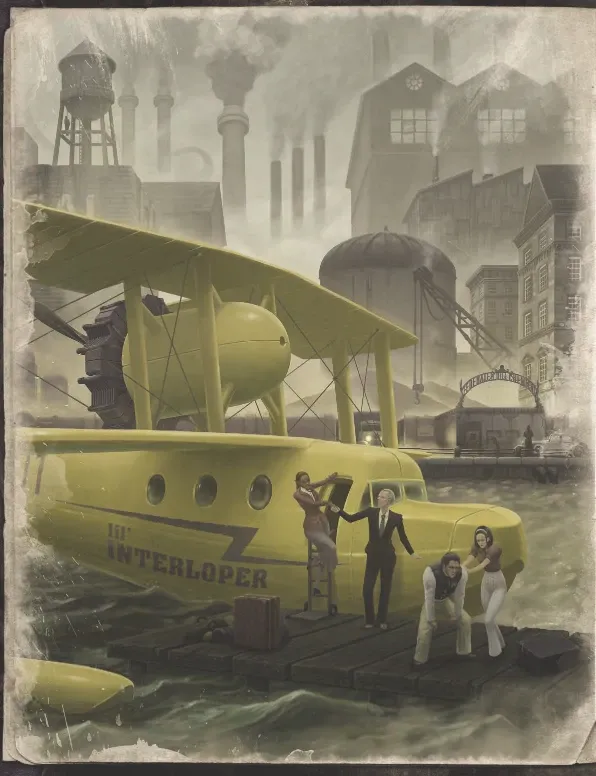
Boston Harbor at ten held no eccentric millionaire. It held an aircraft — a great amphibian, a British prototype, her engines already warm — and Leon Pasqualle beside her, and colleagues of his already aboard.
I see you brought a dog, too. It’s fine. Get inside.
Amiga sniffed the lawyer’s trouser leg and wagged her whole hindquarters, and made not one sound, and Nari watched that small performance with complete attention and filed it away.
A couple of hours aloft, inland the whole way, questions answered with you will learn everything in time. Sofia asked about the warehouse, and the men in the Cadillac. Mr. Abelard has his eyes on all points of interest, said Pasqualle.
They came down on a private dock on a wide river, across from three vast plants pouring smoke into the sky, at a rear gate that read FEDERATED OIL AND CHEMICAL. Between dock and factory waited a silver Rolls Royce, and out of the driver’s seat climbed a giant — six foot seven if he was an inch, flame-red hair and beard, a scar down the left cheek, a chauffeur’s jacket above and a Scottish kilt below it.
Good morning. I must ask to search you for weapons.
He took everything, gently, including the black gun with no trigger, and opened the rear door. Inside sat a beautiful blonde woman with a bobbed head and a business dress — Miss Preston, the secretary — and across from her a large man in a suit that could have fed a family for months, thinning grey hair, hazel eyes, and a fat Cuban cigar going like a chimney.
Well, well, he said. Mr. Zweidiger.
Scheidegger, said Clement. Everyone gets it wrong.
Michael Abelard greeted them each by name — he had done his homework — and petted the dog (it’s a lovely dog), and then told his story the way men tell what they have told many times and will keep telling. A wife dead in childbirth, the second son with her. The first — Michael, Jr. — killed in a climbing accident in the Pyrenees, on a rope with his father.
We stumbled upon a group of mi-go.
He said the name the way Clement said altitude, and he watched their faces when he said it. Father and son had run, and in the panic had gone over the edge of a ravine. He drew back the rug across his knees and let them see what was left of his legs.
Thankfully, no, he said, when Nari asked whether the creatures had taken his son. He died jumping into the ravine. As for me — I would have preferred to die that day. I did not get the chance. The cigar turned in his fingers. Those evil creatures are responsible for my son’s death, and I will not die before I have had my revenge. My goal is to find their main base on this Earth, and destroy it.
Eight years of it, he made plain: the real reason his company had paid for the Miskatonic field trips to Vermont; bases in the mountains of the world — the Pyrenees, the Andes, the Green Mountains; the creatures’ hunger for the mineral that bore his lost geologist’s name; the raid on the library for the books that described them. It is obvious the mi-go were behind it. No one in that car needed convincing, and he knew it, and enjoyed it.
Then the proposal. A return to Cobb’s Corners — the best-equipped team he could assemble, ex-soldiers camped close by, constant radio contact, and a doctor, a Miss Matherson, who could teach them everything the company had learned about the enemy’s bodies and weaknesses and technology. Some animals smell the wrongness in them, he added, nodding at Amiga. The locals were compromised, the schoolchildren already strange, the authorities covering for what they did not understand. That is why I need you. I need you to uncover everything.
Sofia, cool as a girl interviewing for a position, asked whether the company had careers for people with her particular experience. I like the way you think, young lady, said Abelard, and looked at Murdoch. I need capable people around me.
Could they refuse? Of course you can say no. The cigar described a small circle. But for every action there is a reaction. You know that. And, more gently, almost warmly: I am not blackmailing you. I want people beside me who have faced these creatures and are still alive. You managed that. That is why.
The car carried them a short way to a six-storey building that from the outside might have been a bank, down a ramp into a guarded underground garage, up an elevator to a quiet fifth-floor corridor. A man in uniform stood at a door beside a second, private elevator — the way to the sixth floor, and Mr. Abelard’s own rooms. Murdoch lifted his employer from the car seat into a wheelchair with the ease of long practice.
Feel yourselves at home, said Abelard. I am so glad we are joining forces. And the elevator door closed on him.
They chose rooms like students on the first day of term. Clement claimed the one beside the lavatory.
He snores, said Susan.
He wants his privacy, said Nari.
The fifth floor was very quiet after that. Somewhere below, the plants worked on into the dark, and the smoke went up over the river, and it had all — the hotel, the clothes, the dropped charges, the rebuilding, the rooms — the smell of money, and not one thing in it that they had chosen for themselves.
Next: Dr. Matherson, and everything Federated Oil and Chemical has learned from the enemy dead it keeps. New clothes, new guns, a plan drawn by soldiers. And at the end of every road the company pays for — Vermont.