

Protagonists
- Charlotte Bly - Jazz Singer (Tasos)
- Dr. Bertrand Sharpe - Psychiatrist (Konstantina)
- Frank Plekanec - Longshoreman, Great War Veteran (Michalis)
- Lucy Pritchard - Reporter (Ioannis)
Monday 15th of September 1919, Clara Winbourne’s Apartment - 13:00 PM
The investigators decide to go to Clara Winbourne’s apartment. She lived in a third-floor apartment on the South End. When they arrive there they knock the door and a young lady opens up the door. It is her roommate, Amelia Lawrence. Amelia works as a switchboard operator and is devastated by the passing of her friend. Her eyes are red rimmed from crying when she answers the door.
Lawrence is happy to answer questions. She invites the investigators inside and ushers them into the living room, which has a few overstuffed chairs and a sky-blue couch. The couch has a black tomcat perched on its back like a thundercloud. There’s also a framed poster of the Diabolist hanging on one wall, staring at the viewer with volcanic green eyes. After offering them homemade coffee cake, Lawrence settles into one of the chairs and offers to help however she can.
The women met six years ago, she explains, while students at Emmanuel Women’s College in Boston. Winbourne was an active listener and asked good questions, although she rarely revealed her own thoughts and feelings on a subject. Over time, the two became inseparable. After graduation, they moved in together.
Two years ago, the pair attended one of the Diabolist’s magic shows. Winbourne stared at him with an expression of abject worship. The Diabolist must have noticed. Toward the end of the performance, he invited Winbourne onstage and had her lie down in a box. The contraption covered her entire body, except for her head and feet. Once she was secured inside, Imhoff sawed the box in half and separated the pieces, to the shock of the crowd.
In the months that followed, Imhoff began seeing Winbourne. Lawrence didn’t know what to make of the relationship. “It was more than a flame, you understand,” she says, “it was an obsession.”
Winbourne began spending more time with Imhoff, and Amelia felt a wall rising between them, brick by brick. “I asked her, as a friend, if it was wise for a girl in her situation to be spending so much time at the lodgings of a bachelor, and she actually laughed at me! ‘Oh Amelia,’ she said. ‘He doesn’t care about that. He’s above it. The things he cares about—that we care about—you can’t even imagine.’”
In the weeks leading up to her murder, Winbourne became increasingly distracted. She would forget things and keep odd hours. At times she dropped hints that she was working on a project, although she wouldn’t say what it was. She brought home a cardboard box one evening full of surgical instruments, which she tucked away under her bed. The next evening, Winbourne dressed in her nurse’s uniform, took the box, and went out. She never came home.
The investigators ask Amelia for permission to check Clara’s room and she agrees. Clara had a cramped bedroom with a bed, bookshelf, wardrobe, and desk. The bookshelf is full of textbooks on advanced surgical techniques. The wardrobe contains a few sets of nursing uniforms in addition to mundane clothes. The desk has a collection of fine stationary, calligraphy pens, and notebooks. There’s also a roadmap with a section circled in blue pencil and the word “Susurrus” scrawled next to it. Investigators who use this map can make their way to Susurrus Chapel.
As they prepare to leave, Lawrence asks the investigators to promise that they’ll get to the bottom of what really happened Imhoff struck her as desperate, like a man living on borrowed time, but not a religious zealot.
Monday 15th of September 1919, Joseph Garland’s Office - 15:00 PM
Dr. Sharpe realizes that he knows a pulmonologist called Joseph Garland and has heard rumors that the doctor shutdown his office temporarily in order to focus writing a book.
The investigators decide to visit Garland’s office nevertheless. Charlotte manages to lockpick the door without alerting the neighbouring notary office. They all enter in Garland’s doctor’s office which seems empty for a long time. They search his desk and they don’t find any photo of a family member, he seems like a person who lives alone.
Before leaving the office they find out a torn envelop with Garland’s home address written on it.
Monday 15th of September 1919, Joseph Garland’s Home - 17:00 PM
The investigators go to Joseph Garland’s home address but they find there a happy family who bought the house from Garland 2 months ago. They have heard rumours tha the doctor moves to Concord.
Without any more clues they decide to visit Orson Thurber’s apartment and check what this old guy has to hide.
Monday 15th of September 1919, Orson Thurber’s Apartment - 18:00 PM
Orson Thurber lives in a modest second-floor walk-up apartment in Roxbury, one of Boston’s working-class neighborhoods. The building is a weathered brick tenement with a narrow, creaking staircase that echoes with each footstep.
The apartment consists of three cramped rooms: a combined living area and kitchenette, a small bedroom, and a bathroom. The ceilings are low, with water stains blooming in the corners like mold.
Living Area: The main room serves as both parlor and workspace. A worn sofa faces a small coal-burning stove. Against one wall sits a workbench scattered with carpentry tools—chisels, planes, and small clamps—alongside sketches of stage set designs. The drawings show remarkable detail: collapsing staircases, false walls, and trap doors with hidden mechanisms.
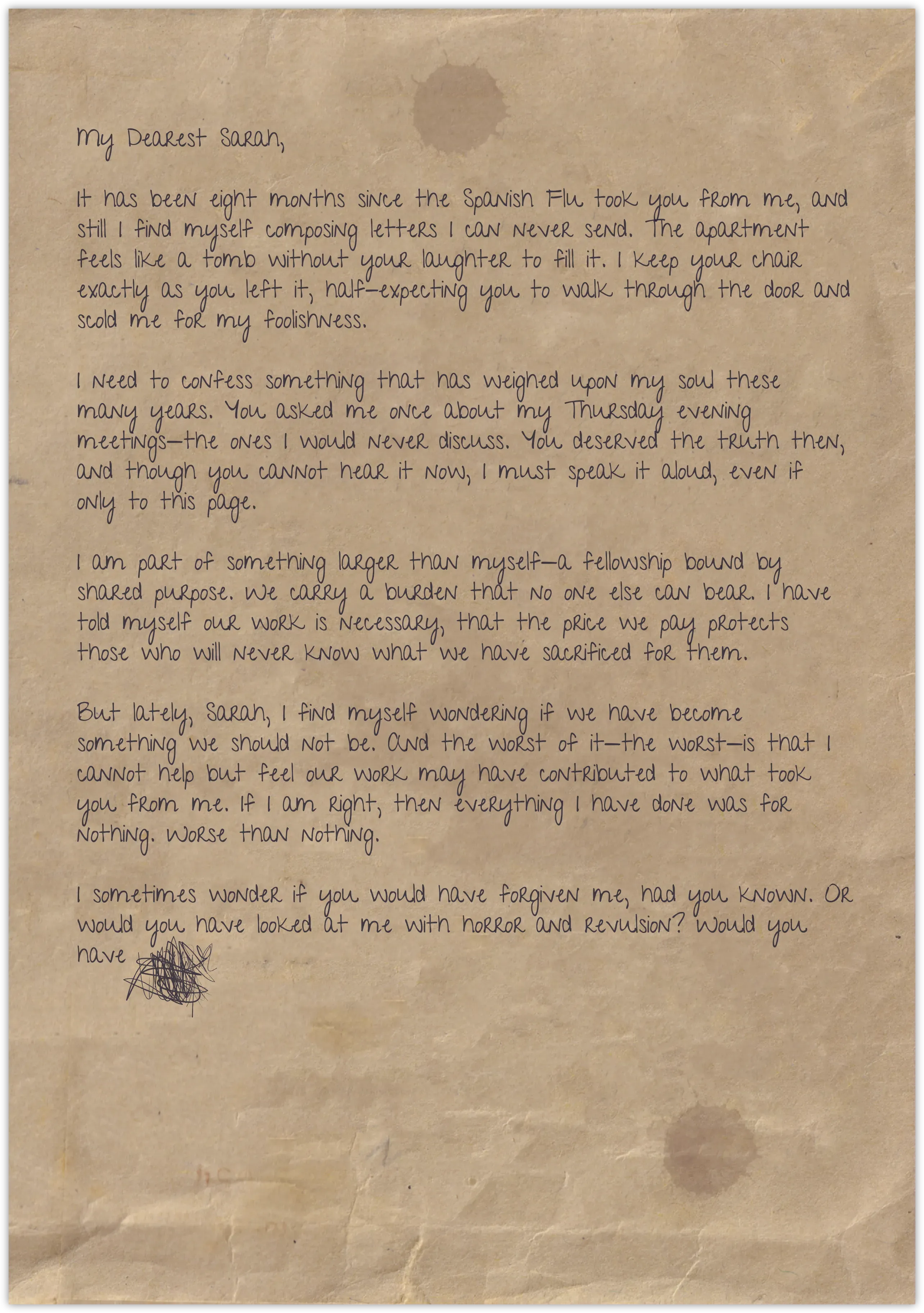
By searching the workbench the investigators find a sealed envelope addressed to “Sarah” in Thurber’s handwriting, never sent. Inside is an unfinished letter expressing his grief over his wife’s death from Spanish Flu and his guilt about “the burden I’ve helped place upon the world.”
Under the sofa cushions they find:
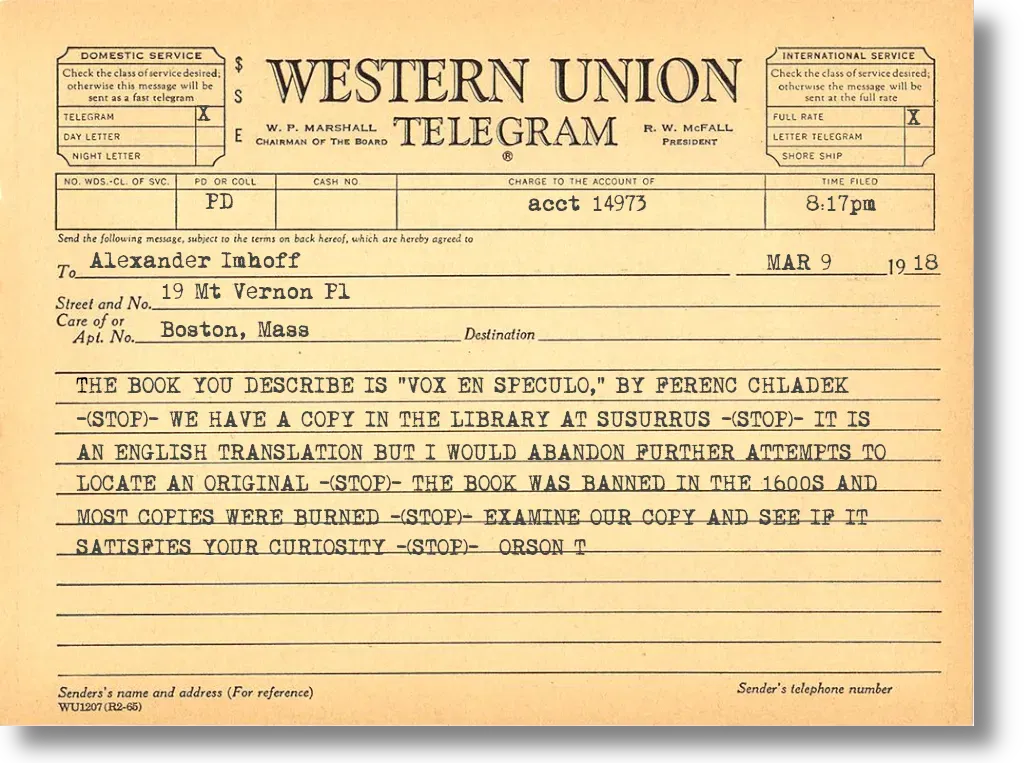
- A western union telegram
- 73 cents in loose change
A small dining table is covered with a Go board mid-game, with black and white stones arranged in a complex pattern. Beside it rests a well-thumbed book on Go strategy with notes in the margins.
Bizarelly enough the find 3 cages with 2 birds each.
Kitchenette: A simple counter holds a hot plate, a few dishes, and a tin of Earl Grey tea. In the cupboard, investigators find basic provisions: tinned beans, crackers, and a jar of honey. There’s also a small bottle of laudanum prescribed for chronic back pain.
Bathroom
In the bathroom the investigators find various medicines for age-related ailments and a small vial of glowing green fluid.
Bedroom
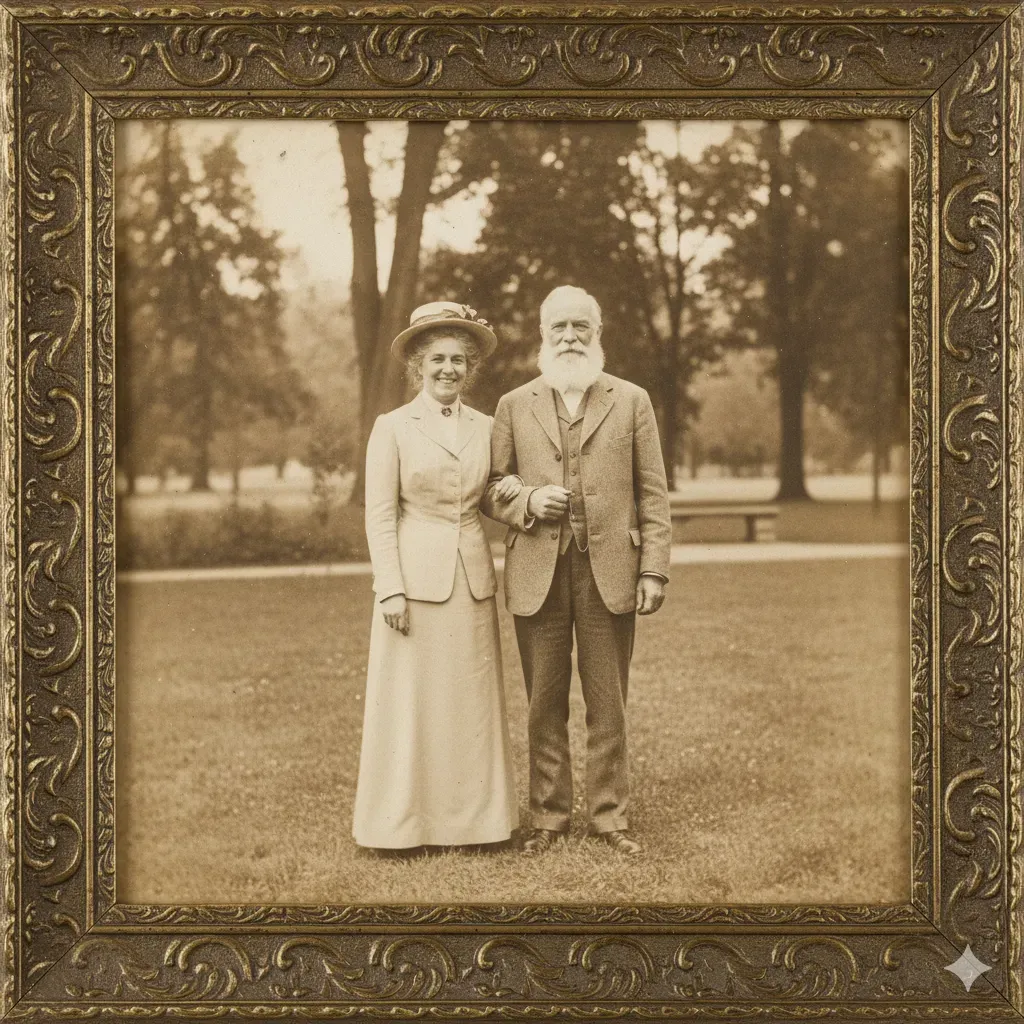
The bedroom is a modest small room. They can find in a small table next to the bed a framed photograph of Thurber and his late wife Sarah at Horatio Harris Park, both smiling.
The apartment feels lonely, maintained by a man going through the motions of living. There are no fresh flowers, no recent mail, no signs of visitors. The only touches of warmth are the Go board—suggesting regular games with friends elsewhere—and the photograph of Sarah, kept close at hand.
The overall impression is of a man carrying a tremendous burden, living simply and quietly, finding what small pleasures he can in craftsmanship, strategy games, and memories of happier times.
Before leaving the apartment Frank decides to free the birds.
The investigators call it a day and Dr. Sharpe proposes to meet up early in the morning and go visit the Sussurus Chapel now that they have the map they found on Clara’s apartment.
Frank & Lucy go for a drink in the Black Cat Jazz Club.
Tuesday 16th of September 1919, Sussurus Chapel - 13:00 PM
Fifteen miles outside of Boston, a rutted dirt road wanders through the weed-choked pastures of Holcombe farm and plunges into a forest. The trees here have gnarled branches and their bark oozes slimy sap. The forest floor is covered in a carpet of poison ivy.
It takes a long time to trace the winding dirt roads to the chapel. Even lifelong Massachusetts residents find themselves struggling to follow their roadmaps.
The road winds through this forbidding woodland for some miles before petering out in a clearing with unkempt grass. Here lies Susurrus Chapel. The building has walls with peeling white paint, like curlicues of almond bark coming off a moldy cake. The cloudy windows are unbroken, and the place appears abandoned. There is no cross on the steeple.
Lucy decides to have a look around the chapel for signs of freshly dig graves.
Entering the chapel
Darkness seems to press against the windows of the chapel, like an aquarium full of black water. A few bats fly in and out of the belltower on nocturnal errands. A successful Spot Hidden reveals that there are tire tracks in the soft ground outside. Cars have parked here sometime in the past few weeks.
The doors to the chapel are unlocked and swing open with a groan. Those impressed by the decrepitude of the building’s exterior will be surprised to discover that the interior is immaculate. The floors are covered in green marble tile and the walls are of varnished wood, decorated with richly carved moldings and wainscoting. There are no electric lights. There is a small narthex, with a door on one side that opens into a small library and another that leads to the belltower. A staircase leads to a balcony overlooking the sanctuary. Straight ahead, a set of double doors lead into the sanctuary proper.
Library
The air in this room is redolent with the earthy smell of old paper. Every inch of wall space is taken up by bookshelves, except for a doorway leading into an office, and a small potbellied stove. A worktable sits in the center of the room, with stacks of paper and fabric, bottles of glue, and heavy cardboard for covers arranged on it.
Beside these materials sits a brailler, a device similar in appearance to a typewriter. Instead of printing words on a page with ink, it stamps indentations into paper that the blind can read by fingertip.
An old book in Russian sits open on the desk, next to a stack of paper with braille writing. The remains of several burnt books lie in the stove.
Dr. Sharpe & Charlotte try to search the library and they both find a different book they become obsessed with. They sit wherever they can and start consuming the content.
Frank goes to the small office next to the library to have a look.
Office
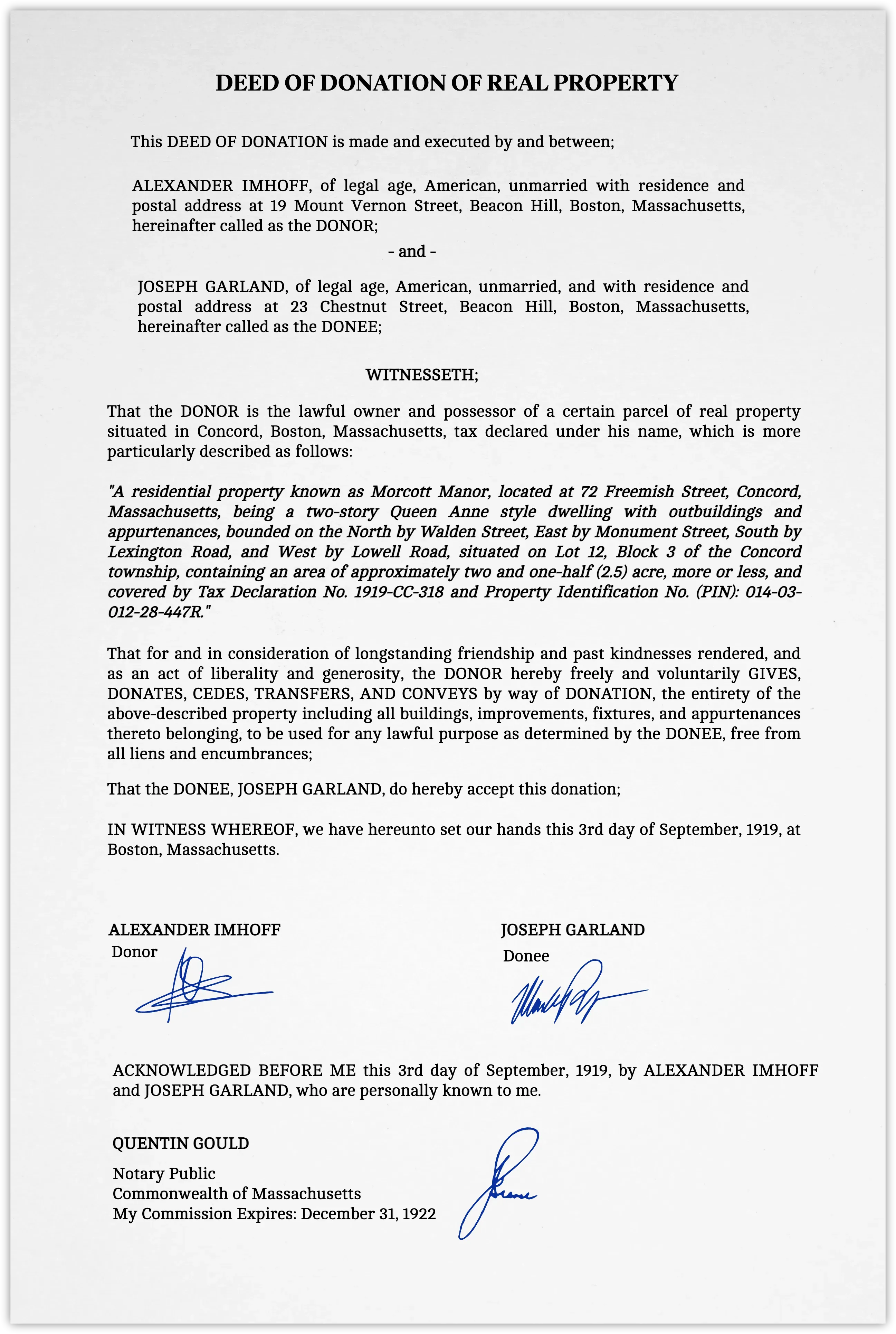
This windowless room is little more than a closet, with enough room for a desk, a lamp, and a rolling chair. Inside the desk, investigators will discover a few file folders. One of these files is marked “Imhoff, Alexander.” Within it, they discover a deed of sale, will, and some other legal documents. Apparently, shortly before he died Imhoff spent an exorbitant amount of money purchasing a mansion called Morcott Manor in Concord, Boston. He then wrote a will, bequeathing all his possessions to Joseph Garland. The address for Morcott Manor is listed as 72 Freemish Street.
There is a large stock of fine cigars and pipe tobacco in another of the drawers. If the investigators examined the humidor at Imhoff’s apartment, they note that the aroma from the tobacco is identical.
Belltower
Frank meets Lucy who finished searching outside the chapel and they decide to check out the belltower.
The belltower is square and has a few old crates pushed against the walls. A rickety staircase wraps around the inside of this tower, with nothing but a brittle railing separating investigators from a fall down the open shaft. The stairs ascend for some 45 feet before terminating in a small landing. A bronze bell hangs here, turned green with corrosion. There is also a folding chair, a few empty beer bottles, and a tattered copy of the novel The Castle of Otranto. Its margins are full of notes written in pencil, but they are made in some kind of shorthand that is impossible to decipher. The last thirty pages of the novel have been ripped out and are missing.
Sanctuary
The sanctuary is airy, with a high ceiling and the dome interior lost in shadow somewhere overhead. Square marble pillars called pilasters line the walls. At the front of the room on a raised dais is an altar—a marble slab supported on the backs of two stone statues. The statues have the head of a man and the body of a lion. Hanging on the wall above the dais is a Penrose Triangle cast from bronze. There is no Christian iconography anywhere to be seen.
Wooden pews flank a central aisle leading up to the dais. There are slots on the back of the pews with clay tablets tucked in them. Each of the tablets has a bronze stylus for stamping letters into the clay. Many of the tablets have messages on them, written in cuneiform.
As Lucy & Frank pass among the pews, they hear an urgent squeaking. As it happens, the dome of the Susurrus Chapel creates an unusual acoustic effect, like the Whisper Gallery in the Statuary Hall of the U.S. Capitol building. Sounds made at one pole of the phenomenon are transmitted to the other pole with eerie clarity. The squeaking that the investigators hear is an echo being carried to them from behind the stone altar.
The altar is covered in small puddles of congealed blue wax, likely caused by candles. Investigators who examine the altar closely will discover a cardboard carton tucked behind it. Peeling open the box’s flaps, they find a pile of dead baby birds inside. A rotten smell wafts out of the moist, sticky interior. The chicks are featherless and have wrinkled, scrotum-like skin. One of their number still clings to life, opening its mouth wide and chirping piteously.
The box has an address written on it: Morcott Manor, 72 Freemish Street, in Concord.
Balcony
A staircase with crooked wooden steps ascends to the balcony. The pews here are covered in a thin layer of dust, like fur. The balcony is cloaked in shadow and allows a perfect vantage point from which to observe events unfolding in the sanctuary.
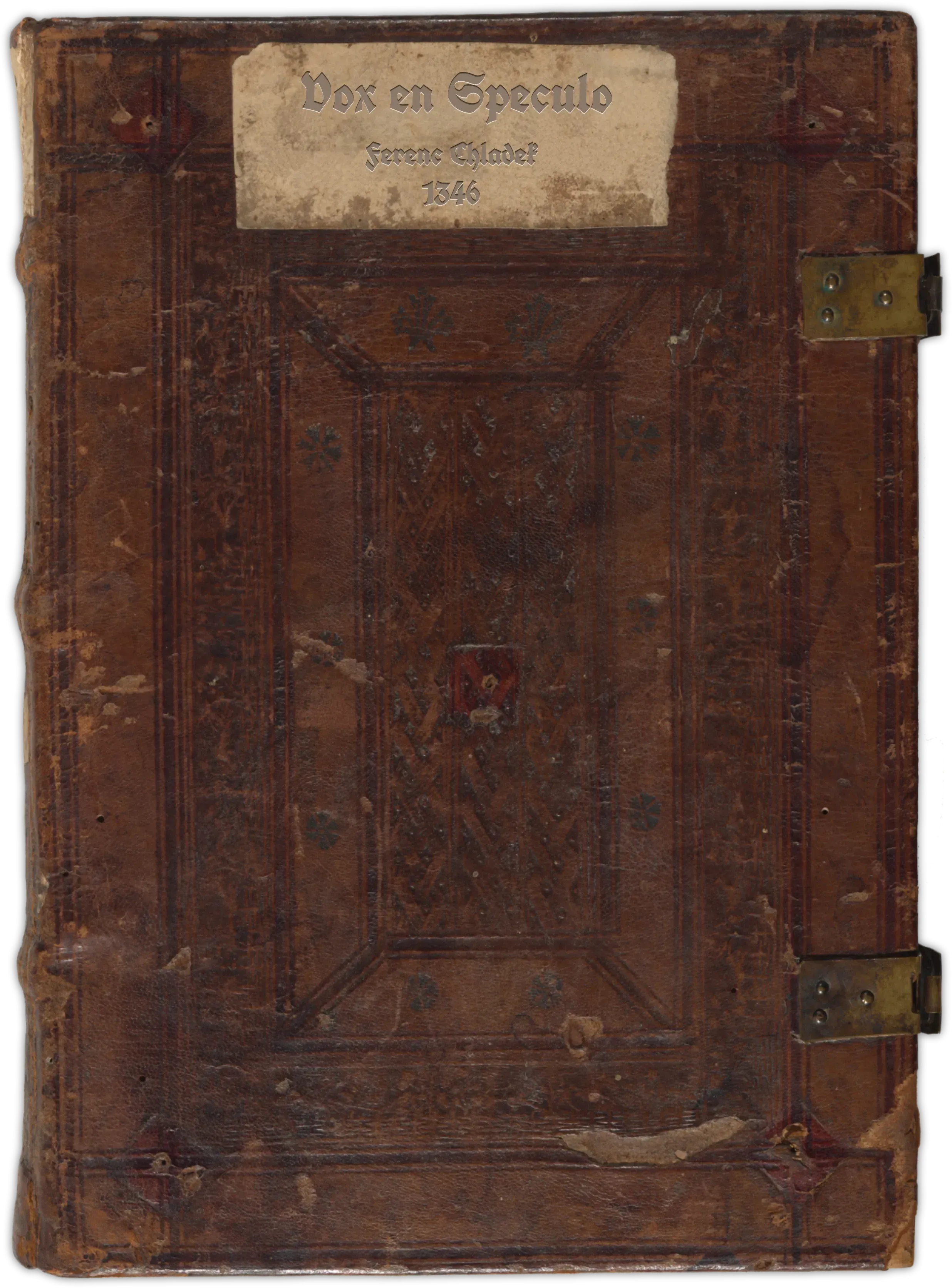
Lucy & Frank decide to go find the others in the library and get the hell out of here. Lucy fails to find the Vox en Speculo book (failed Library Use).
The Cultists Arrive
As the investigators draw near to the end of their exploration of the church, they hear the crunch of car wheels on gravel. Headlights illuminate the chapel windows, sending shadows slithering across the sanctuary. Someone has arrived. Over the next ten minutes, cars stream into the clearing and men and women get out. There are thirty of them in all, of many different ages and races. The Cultists retrieve purple robes from the trunks of their cars and put them on before milling around to greet one another. The mood is both friendly and solemn.
The investigators have a short time to hide. They climb to the balcony and hide before the cultists enter the chapel.
The cultists gather in a circle at the dais, speaking loudly to one another. The leader is an old man with a white beard, whom the investigators recognize as Orson Thurber.
Thurber explains that “Joseph” is ill and that he will be leading tonight’s ceremony instead.
Two of the cultists flank a middle-aged man, supporting him by the arms as he shuffles along. His face is gray as curdled cheese, his eyelids droop, and his robe hangs in folds from his twiggy frame. He has the look of a man with a terminal disease.
One of the cultists sets some tall blue candles on the altar and lights them while another produces a cardboard box from his robe. The other cultists grimace in discomfort as the sound of chirping fills the room. The box is full of baby birds. The sound is audible even in the balcony—there are numerous birds chirping this time, and they are in better health.
One by one, the cultists take a baby bird from the box and cup it in their palm. Only one cultist doesn’t take one—a lanky man in his twenties. His robe is a lighter shade of purple than the others. Once everyone else has one, the lead cultist with the white beard speaks.
“With living flesh, we sate the hunger of the Passenger,” he says. “Long may it sleep.”
“Long may it sleep,” they all echo.
With that, they throw their heads back and pop the birds into their mouths. There is no chewing—each cultist swallows the bird whole. This is no easy task, but the cultists have clearly performed it numerous times. The birds squirm and squeak as they go down. The cultists look queasy and a few gulp hard to suppress a gag reflex. They look more like patients taking an unpleasant medicine than religious fanatics performing a ritual.
With that out of the way, the leader turns to the sick man. “Edgar, are you sure you want to do this?”
He nods. “I am, Orson. I want to lay down the burden on my own terms—here, surrounded by friends.”
The group presses in, and a few reach out to place a comforting hand on his arm or shoulder. They share stories about their favorite memory of Edgar; memories of how he taught their children geometry, how they played card games at his house until late in the night, and how he built a wheelchair ramp for one man’s wife when she was paralyzed from polio.
Edgar looks at one of his companions and says, “Guess you’ll never have to return my tools, now.” Several people laugh, but their cheeks are wet with tears.
“I love you all,” Edgar says. His voice is thick with emotion. “It has been an honor to know you, to serve alongside you in this meaningful work. The world owes you a great debt, though it will never know your names. Goodbye, my friends.”
With that, he stands in front of Orson and squares his shoulders. Orson dips his ring and middle fingers in a small vial of glowing green fluid, and then traces a symbol in the air in front of his face, while reading some words from a clay tablet.
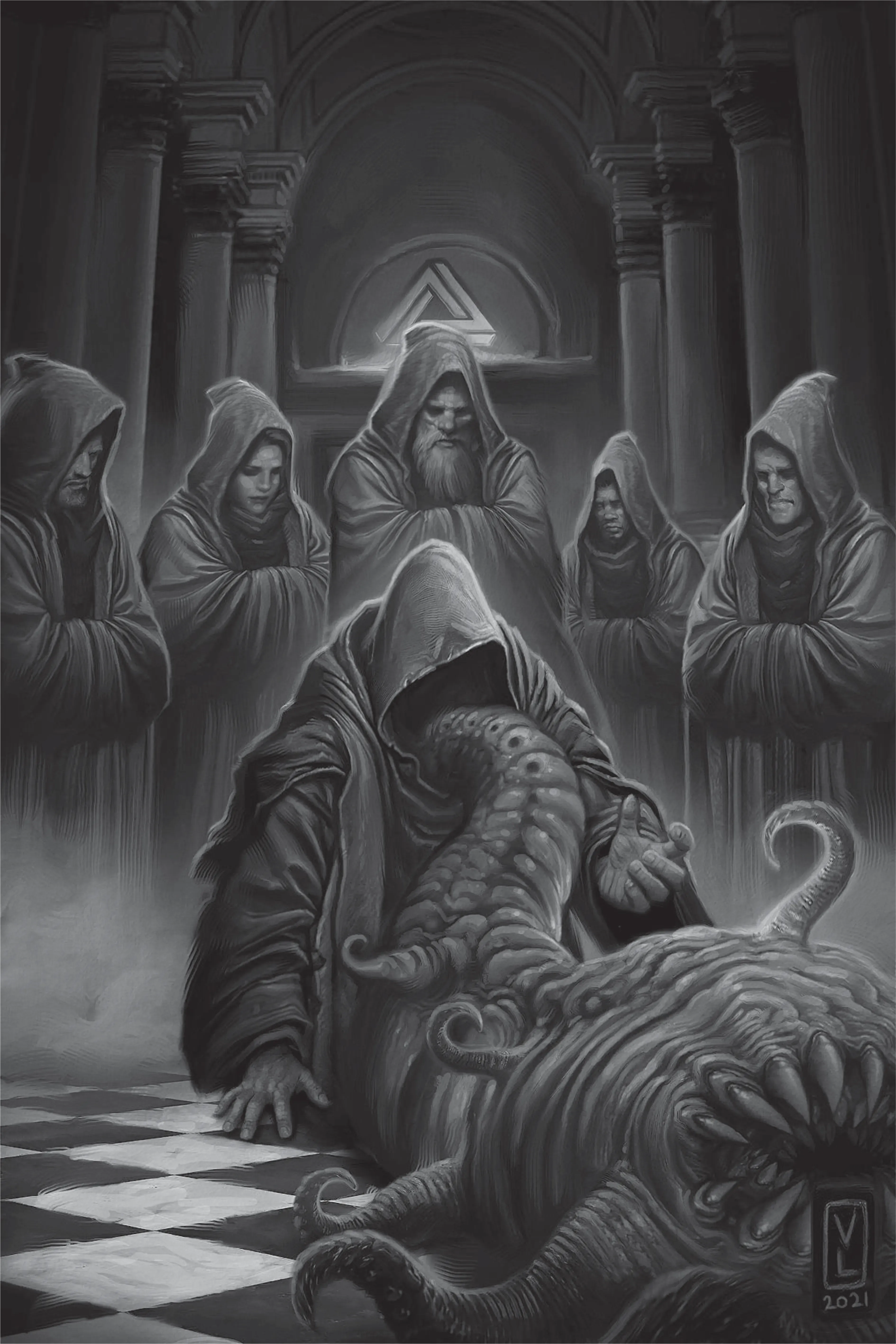
For a moment, nothing happens. Then, Edgar begins to convulse. His skin swells and stretches, and a huge bulge moves up his throat. With a groan, he leans over and vomits a creature of glistening flesh and curling tendrils onto the ground. The torrent pours out for longer than one would expect, and Edgar’s entire body deflates like a sack. Investigators will watch in horror as Edgar’s collapses into a pile of skin and an oily black creature emerges from his body, like a grub from a chrysalis. The beast is so big, it seems as though it took up most of Edgar’s body.
The creature opens a dozen tiny orifices along its body and discharges maggots, as though it were sweating them out. A sound like rabbits screaming emanates from its mouth, while a vile stench fills the sanctuary. The tendrils along the creature’s body curl and stretch, like roots seeking moisture.
Orson brandishes a small Penrose triangle amulet with one hand and holds out a baby bird with the other. The creature darts a tongue out, snaps up the bird, and bites down with a juicy crunch. While this is happening, Orson draws a bronze dagger and stabs the beast. It spasms and lets out a squeal before going limp. Next, Orson beckons to the twenty-year-old man. “Tim, do it quickly.”
Tim shudders. Getting down on his hands and knees, he sinks his teeth into the side of the creature. The beast ripples and flows like water, running up into his mouth and pouring down his throat. The young man falls backward and clutches at his neck with an urgent choking sound. A few seconds later, it’s over and the beast is gone. The enormous creature has somehow disappeared inside the man’s thin body. The other cultists help Tim get to his feet and someone dabs at the corner of his mouth with a handkerchief.
“You now carry the Passenger,” Orson says. “It is a great and terrible burden, but you will not bear it alone. Welcome to the Penrose Coven.” The others applaud.