


Protagonists
- Charlotte Bly - Jazz Singer (Tasos)
- Dr. Bertrand Sharpe - Psychiatrist (Konstantina)
- Frank Plekanec - Longshoreman, Great War Veteran (Michalis)
- Lucy Pritchard - Reporter (Ioannis)
What’s the story?
For years, Alexander Imhoff was the talk of Boston. The showman performed at the Orpheum Theater, where he would dazzle audiences with mind-readings and displays of hypnosis. To court controversy, he referred to himself as the Diabolist. Among his other talents, the Diabolist was an accomplished escape artist. Audiences in the Orpheum would watch spellbound as he was lowered upside down into a tank of water or locked in a coffin full of snakes. He always found a way to escape. Tragically, Imhoff’s career recently ended in scandal. The newspapers report that he was involved in a ritual murder-suicide at his apartment. Imhoff’s victim, a nurse named Clara Winbourne, was found in the study with two gunshot wounds in her stomach and another in her leg. Imhoff’s body was found nearby, decorated with gold jewelry and occult symbols drawn in blood. He died of an apparently self-inflicted gunshot wound to the head. You have decided to investigate the matter and determine what happened that fateful night.
Sunday 15th of September 1919, Boston Central Burial Ground - 10:00 AM
Alexander Imhoff is laid to rest in the Central Burying Ground in Boston. The cemetery houses the remains of famous Bostonians such as the painter Gilbert Stuart and the poet Charles Sprague. The location is an unusual one, as the cemetery has been closed to new burials for years. No one knows how Imhoff managed to secure a fresh burial plot here.
A cool breeze tugs at the investigators’ coats as they gather with some sixty other mourners in the cemetery. Leaning tombstones jut up from drifts of leaves, their inscriptions worn away by centuries of rain. A gust of wind rattles the brittle leaves in a nearby tree, then rips a few from their branches.
An Episcopal priest stands over the grave and says a few words. Soon enough the ceremony ends, and the pallbearers lower the coffin into the hole. The coffin wobbles, then hits the bottom with a thump. Next comes the squish of spades biting into dirt as they shovel soil back into the hole.
The mourners prepare to leave and the investigators try to approach some of them and try to learn more about “The Diabolist”.
Lucy recognises Lamont Sterling, an overweight man with clover-green eyes who works as a theater critic for the Boston Globe and approches him for a quick talk.
- He considers it a shame that Imhoff’s life ended this way. “When it comes to entertainers, Imhoff was the Real McCoy.”
- Imhoff had eight weeks of shows this summer, and the Orpheum Theatre sold out every night he performed. That man knew how to hold a crowd spellbound. Not even the stagehands know how he did some of his tricks.
- “He was a humbug, of course, but his voice rang with conviction. It was as though he’d managed to convince himself that it was all real. He almost managed to convince me.”
- Sterling mentions that there’s more information about Imhoff available at the Boston Globe. If they’re interested, they can stop by and get a look at the clippings in the archive.
Charlotte recognises Orson Thurber who is an old man with age-spotted hands and a long white beard. He works as a set designer at the Orpheum Theater. As Charlotte approaches him Orson recognises her and gives her a warm welcome.
- He seems confused and sad with the death of Alexander Imhoff
- He worked with Imhoff for more than 15 years and although he was not an easy-going guy they managed to find a way to build trust between them.
- Thurber found Imhoff to be demanding, but thoughtful. Imhoff once loaned Thurber money to buy medicine for his ailing wife Sarah. She passed away from the Spanish flu in 1918.
Dr. Sharpe recognises and old patient of his. Alma Koerner, a middle-aged woman whose makeup is caked on as though she applied it with a trowel.
- She was a devoted fan of Imhoff’s and attended each of his performances.
- “What an extraordinary man. Boston has lost one of its brightest lights.”
- “Alexander told me my deepest secrets. …He had such hypnotic eyes! They shone like lamps. Like he could see right through you.”
After most of the mourners left the cemetery the four investigators find the chance to meet each other and exchange some information.
Dr. Sharpe & Lucy decide to visit the Boston Police Station and Boston Globe
Charlotte & Frank decide to visit Imhoff’s apartment.
Boston Police Station - 11:00 AM
The summer of 1919 is when 1,100 members of the Boston Police Department went on strike. There were several riots over the summer that raged out of control, in absence of enough police officers to maintain order.
That explains why the Boston Police Station is quite empty when Lucy & Dr. Sharpe arrive. There is only one police officer in a room, sitting in a table with a lot of paperwork in front of him.
He tells them to visit tomorrow if they want to meet Police Inspector Livingston as he sips some of the liquid inside the small metal flask next to him.
Phone Call to Boston City Hospital - 11:15 AM
Dr. Sharpe uses a telephone to call to Boston City Hospital and finds out that Clara Winbourne, the victim of Imhoff, worked in that hospital.
Boston Globe - 12:00 AM
In 1919, Boston is home to some of the oldest newspapers in the country. Most are located on Washington Street, which is referred to by the locals as Newspaper Row. It’s a noisy, teeming place. Crowds sometimes gather in the street, waiting for a telegram to bring a news update on a baseball game or an important election. Those results are posted on wooden signboards that hang outside each of the newspaper offices.
Meanwhile, at nearby restaurants, politicians from city hall rub shoulders with lawyers, reporters, and bootleggers to swap proposals, threats, and gossip.
Lucy & Dr. Sharpe arrive in the 7-floor building and they find in the reception area Thea Brouwer. The investigators ask for Lamont Sterling who happily greets Lucy. The investigators ask for access to the Boston Globe archive and Lamont is happy to let them do their research as long as Thea Brouwer tags along.
Thea escorts the investigators into the newsroom. Once inside, they are confronted by the clatter of typewriters and murmur of people talking on extraordinary new appliances called telephones. The newsroom looks like a city skyline, with cigarette smoke rising as if from chimneys, and each reporter’s desk as cluttered as a magpie’s nest.
The investigators are taken to an archive in the back of the building. The room is poorly lit, draped with cobwebs, and crowded with old filing cabinets. Thea sits at a table, doing a crossword puzzle.
The investigators manage to find:
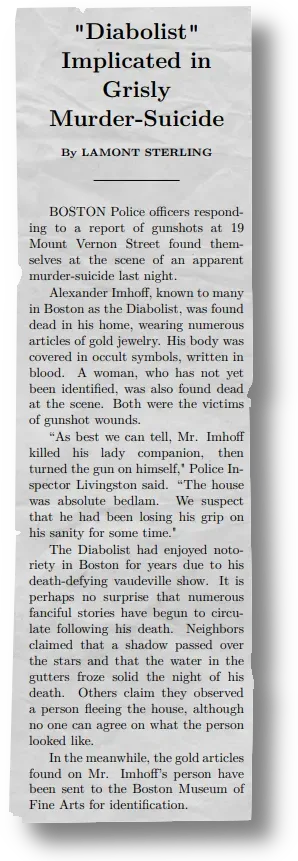
- A newspaper clipping about the murder-suicide that occured on the 13th of September in Imhoff’s Apartment.
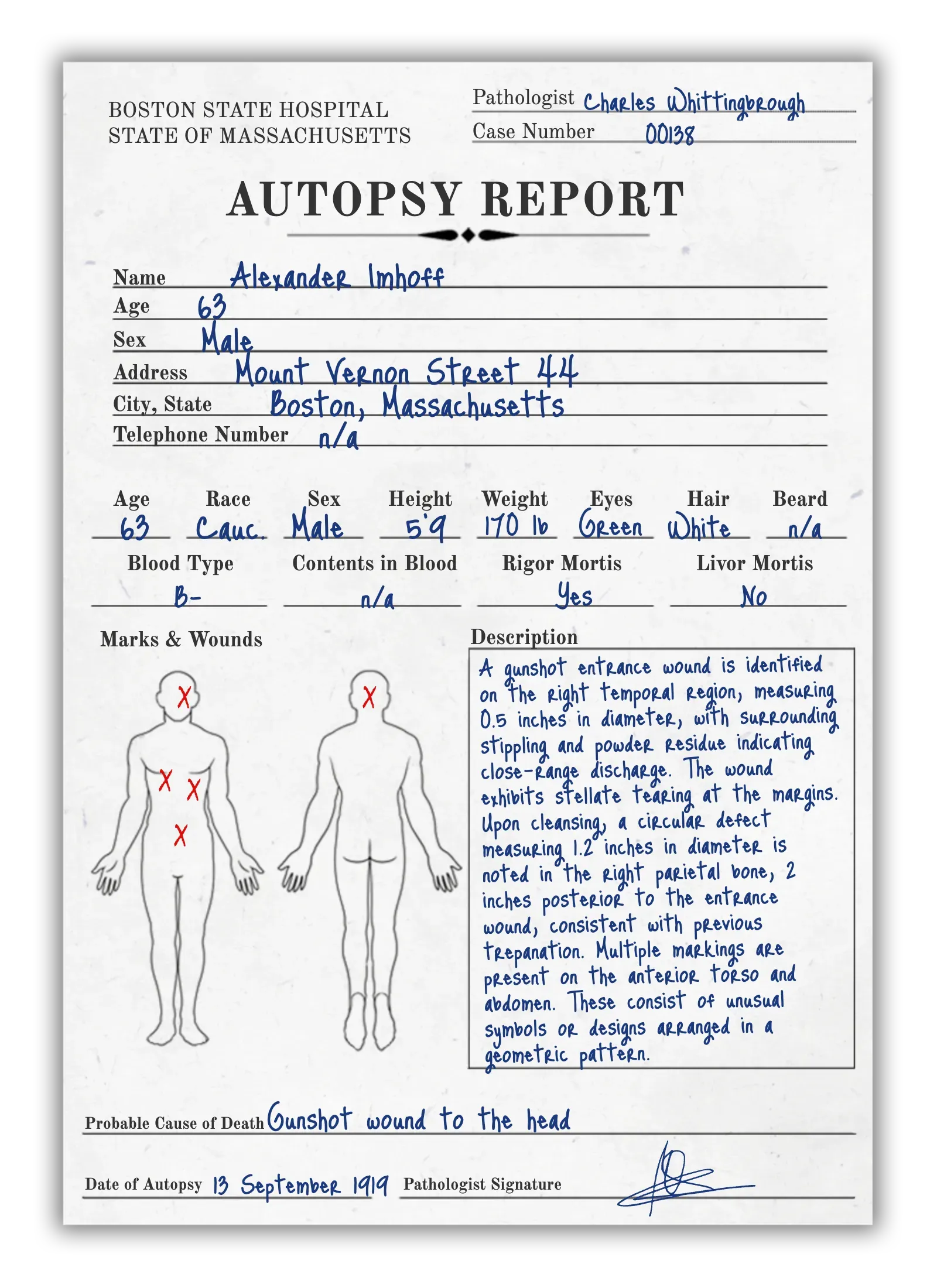
- The draft of an unpublished article, indicating that coroner’s records show that the top of Alexander’s skull had been removed by means of a technique called trepanning. The gunshot wound to his head concealed this fact initially.
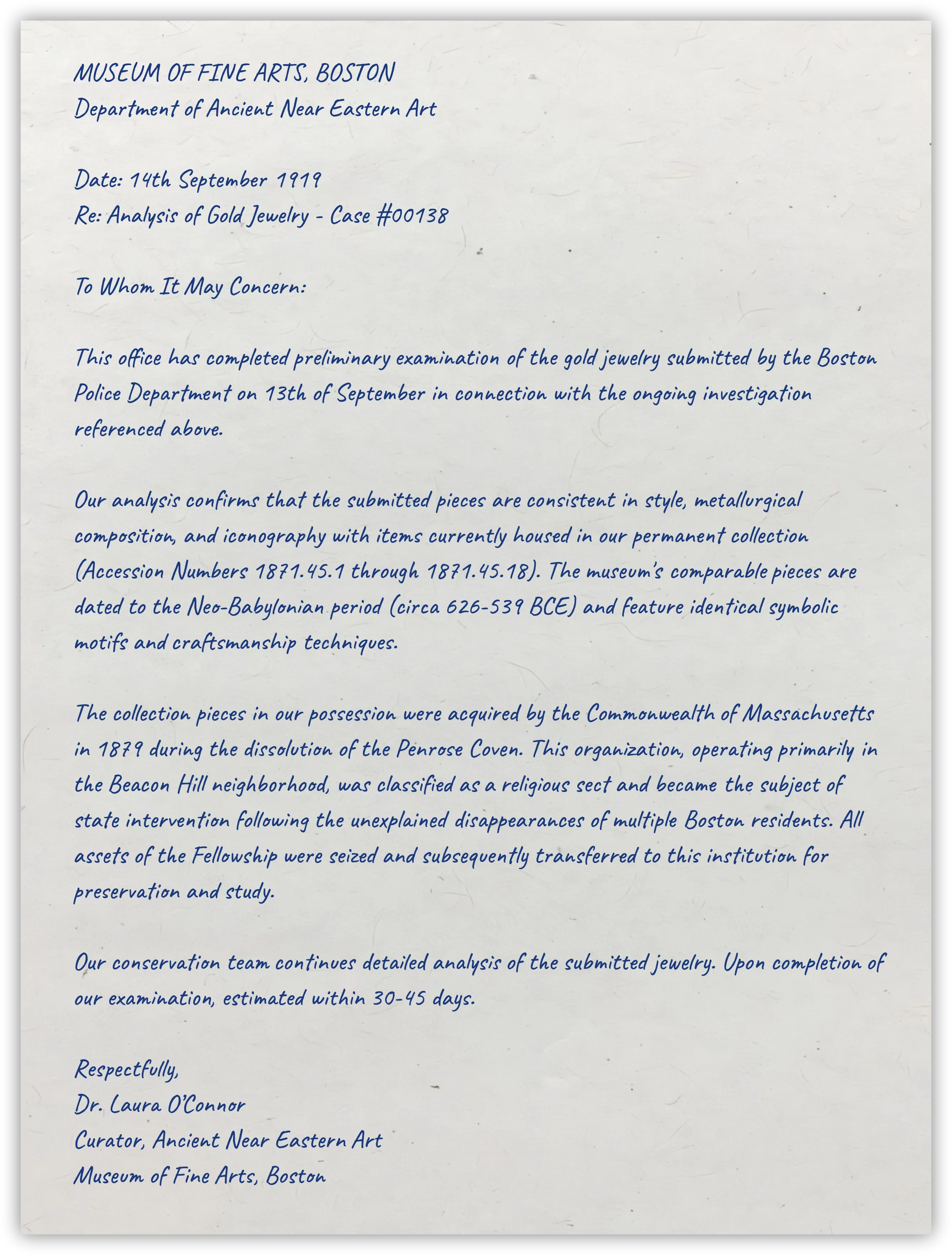
- Curator’s statement from the Boston Museum of Fine Arts, indicating that the gold jewelry matches other pieces in their collection. The museum’s pieces dated from ancient Babylon and were seized by the state in 1879 when they shut down the Penrose Coven, a religious cult responsible for the disappearance of several people in the Beacon Hill neighborhood.
After finding all that information the investigators get permission from Thea to search the older archives for information about Penrose Coven.
Imhoff House - 11:00 AM
Imhoff lived in a beautiful Victorian brownstone on Mount Vernon Place. The front door is locked and there is a notice from the Boston Police Department affixed to it. The sign indicates that the building is a crime scene—admittance is prohibited, and trespassers will be prosecuted.
The front door is on Mount Vernon Place which is quite busy even on a quiet Sunday morning so Charlotte & Frank decide to check the back alley where they find the back entrance and a nosy neighbour who waters his begonias. The old man notices Charlotte and cannot take his eyes off her while she tries to lockpick the back door of Imhoff’s House.
The door unlocks and both investigators slide in. They decide to investigate first the second floor.
Second Floor
The stairs to the second-floor end in a small landing. There are doors here leading to the master bedroom, the study, and a second bedroom.
Second Bedroom
The investigators flip a light switch when entering the room, the light turns on, briefly illuminating the scene. Then the bulb bursts like a glass blister and the light goes out. The tinkling sound of broken glass fills the darkness.
In the brief flash of light, a grim tableau is revealed. Two tables fill the room, each fitted with leather straps for wrists and ankles. The head of each table is stained dark with blood and there are similar stains below where blood must have pooled on the wood floor.
There is a worktable against a wall with several metal trays. Whatever tools were arranged here are probably taken by the police detectives as evidence. A few strips of gauze and bits of thread for sutures are all that was left behind.
Study
The study is lined with bookcases, which are all empty and draped with a bunting of cobwebs. The room is dominated by a slab of a desk, with a surface like a castle drawbridge. There is a fine Underwood typewriter on top. In one corner, there’s an old globe sitting on a stand.
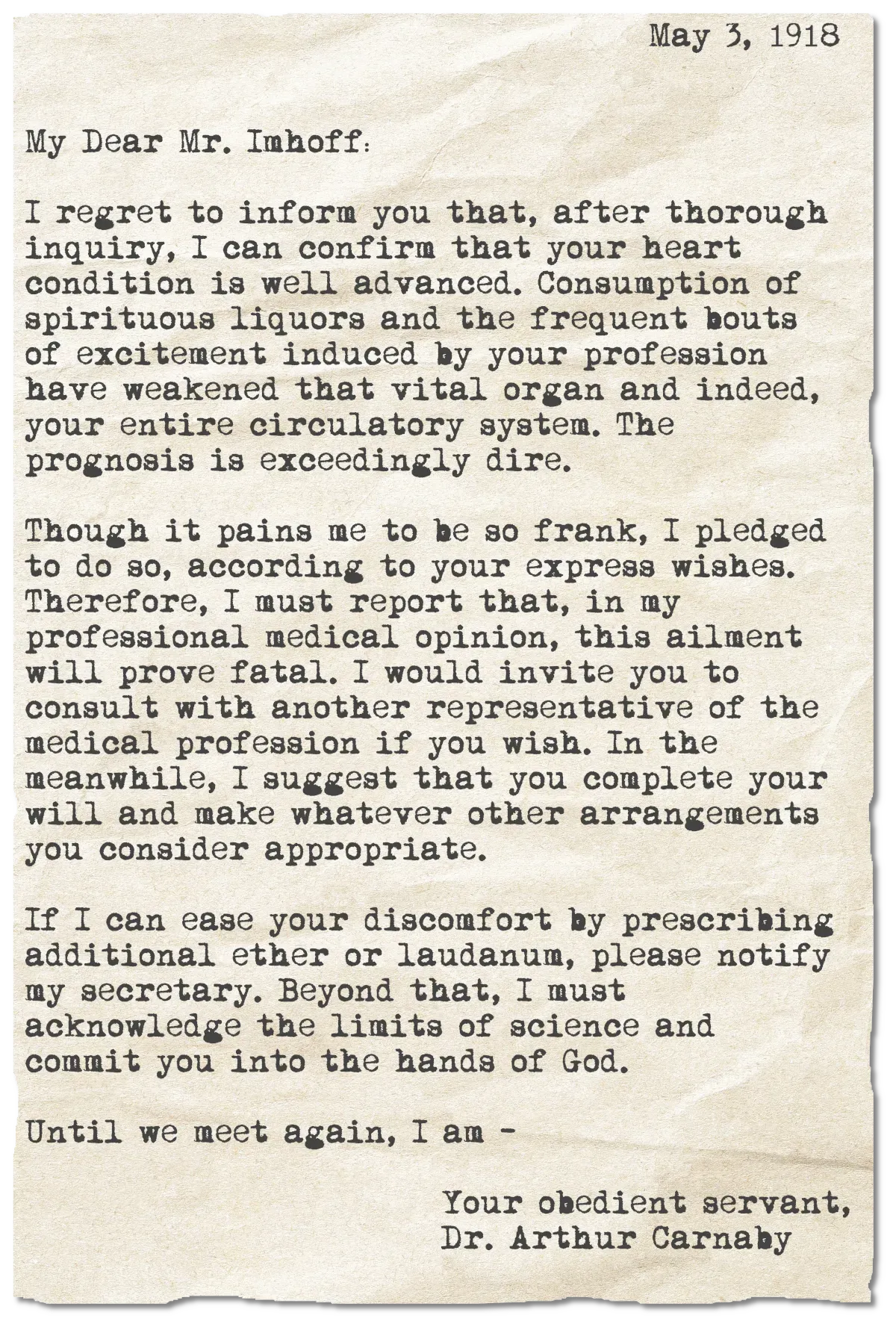
- The desk drawer has a few letters inside. There are past due notices for rent and coal, as well as some invoices from an auction house in London for “Babylonian manuscripts.” Importantly, there’s also a Letter from Dr. Arthur Carnaby, providing a diagnosis of Imhoff’s heart condition
- The globe is a humidor with a hinged lid. There must once have been a fine collection of pipe tobacco inside, but it has all been removed. A few bits of leaves lie at the bottom.
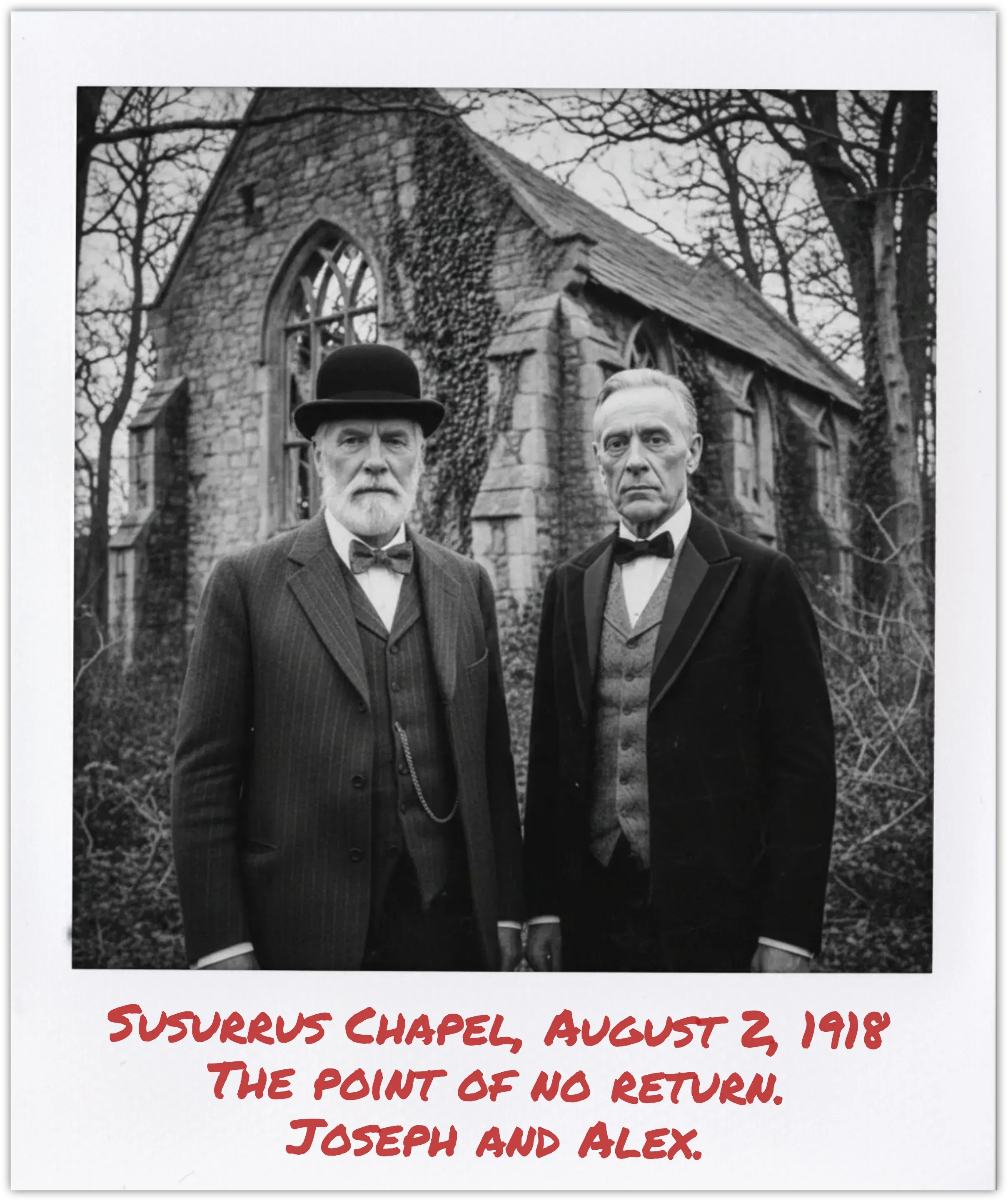
- A black and white photograph hangs above the desk. It is a recent photo of Imhoff standing with a tall, bearded man in front of a dilapidated church. There is a message written on the back of the photograph. “Susurrus Chapel, August 2, 1918. The point of no return. - Joseph and Alex.”
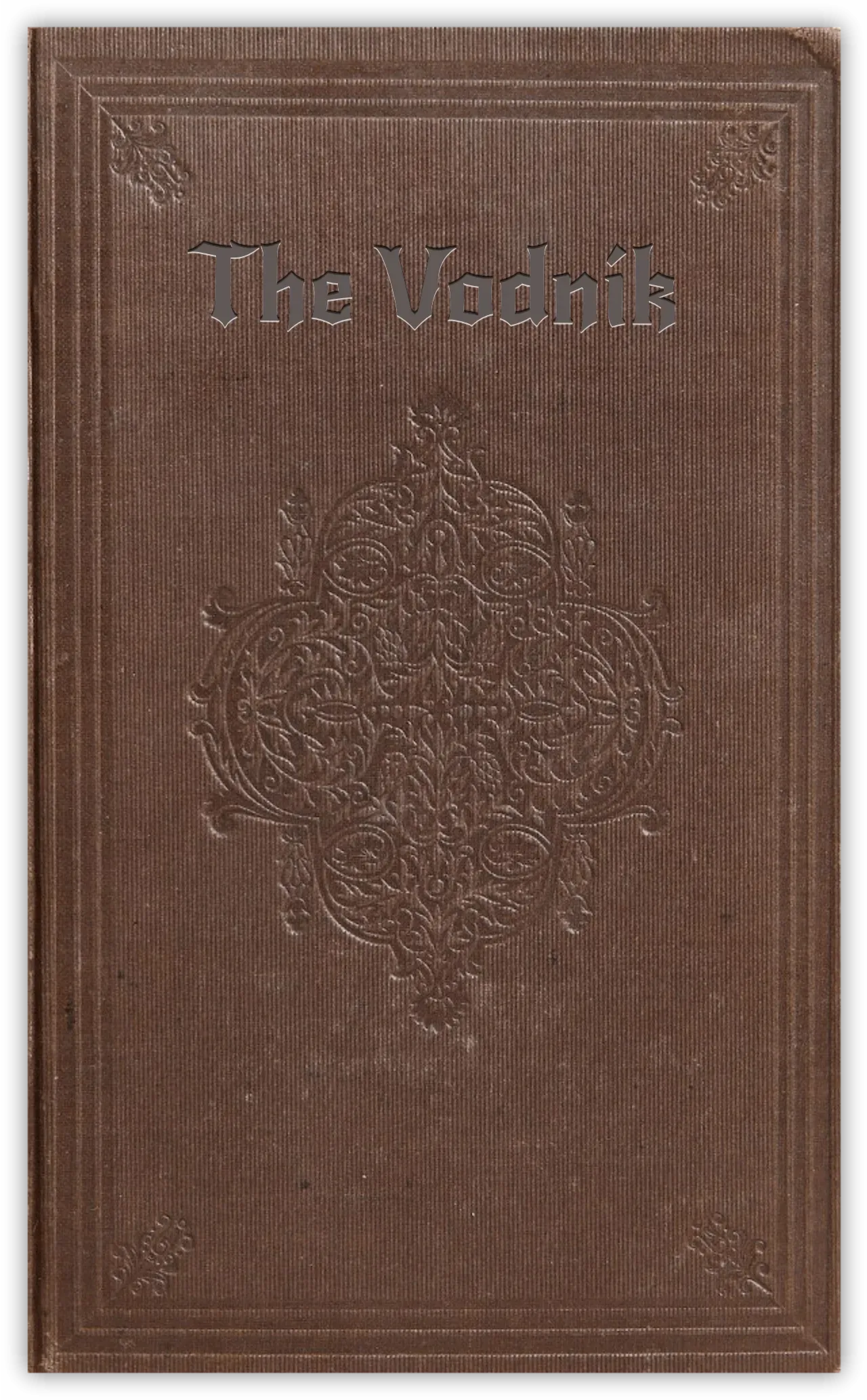
- On the top shelf of one of the bookcases is an ancient tome with beautiful, illuminated pages. The book is entitled The Vodník and it must have been missed when the room was cleared out. It is written in a language that the investigators don’t understand.
Master Bedroom
The space is dominated by a four-poster bed hung with wispy curtains. The curtains blow suggestively, stirred by a breath of wind coming from the open window. There’s a large shape under the covers.
Upon closer investigation, the shape in the bed proves to be nothing but a pile of pillows, haphazardly covered by a blanket when detectives searched the room a few days ago.
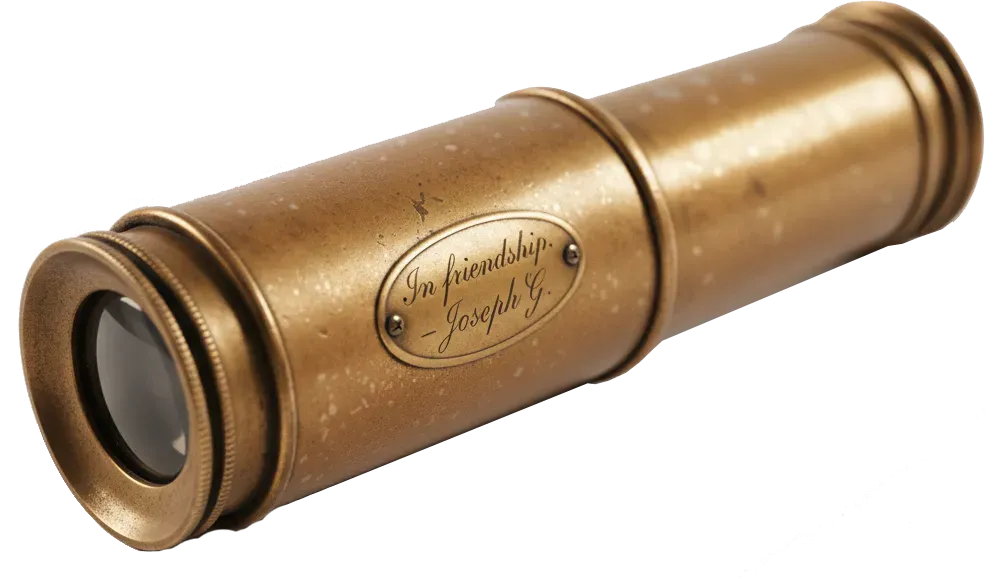
The investigators discover a box under the bed. Inside is a collapsible spyglass with a brass plate on the barrel that reads “In friendship. - Joseph G.”
Charlotte looks through the spyglass and coincedently finds out that a young guy in the park opposite the house is searching for something and constantly looks towards Imhoff’s house.
Ground Floor
The apartment is full of silence, like a glass brimming with water. Upon entry, investigators are confronted by the rich aroma of pipe tobacco.
On the ground floor, a corridor runs from the front to the rear of the house. There’s a staircase ascending to the second floor.
All the doors to rooms are on the left, leading to a den, a dining room that has been converted into a workshop, and the kitchen.
Kitchen
The kitchen has cherry cabinets and granite countertops. There’s a large icebox, and a well-stocked pantry. The tile floor is swept and immaculate.
By searching the room they find some steel knives in the drawers.
Workshop
The dining room appears to have been converted into a workshop where Imhoff built many of his stage props. There is a work bench, a peg board on the wall with hooks for tools, and a drafting table with a hand-drawn schematic for a complicated lock.
The walls are adorned with circus posters from around the world. Tattooed and bearded women, Siamese twins, and all manner of grotesqueries leer at the investigators. Many of the posters also celebrate Imhoff the Diabolist, his eyes open wide in a penetrating, hypnotic stare.
Searching the room yields some interesting items:
- Set of handcuffs
- Straitjacket with a strap that, when pulled, causes the bindings to loosen.
- Large padlock
- Set of lockpicks in a small wax pouch, suitable for swallowing and regurgitating.
- A Chinese water torture cell, a six-foot-tall box with glass sides. When in use, the box is filled with water and the performer is lowered inside, head-first. The lid to the box has a hole in it to admit the performer’s feet. When shut and locked, the lid secures the feet, as though in stocks. Curtains can be drawn to hide the performer from view. The lid is secretly hinged so it can pop open once the curtains are drawn, allowing a performer with some gymnastic ability to climb back out.
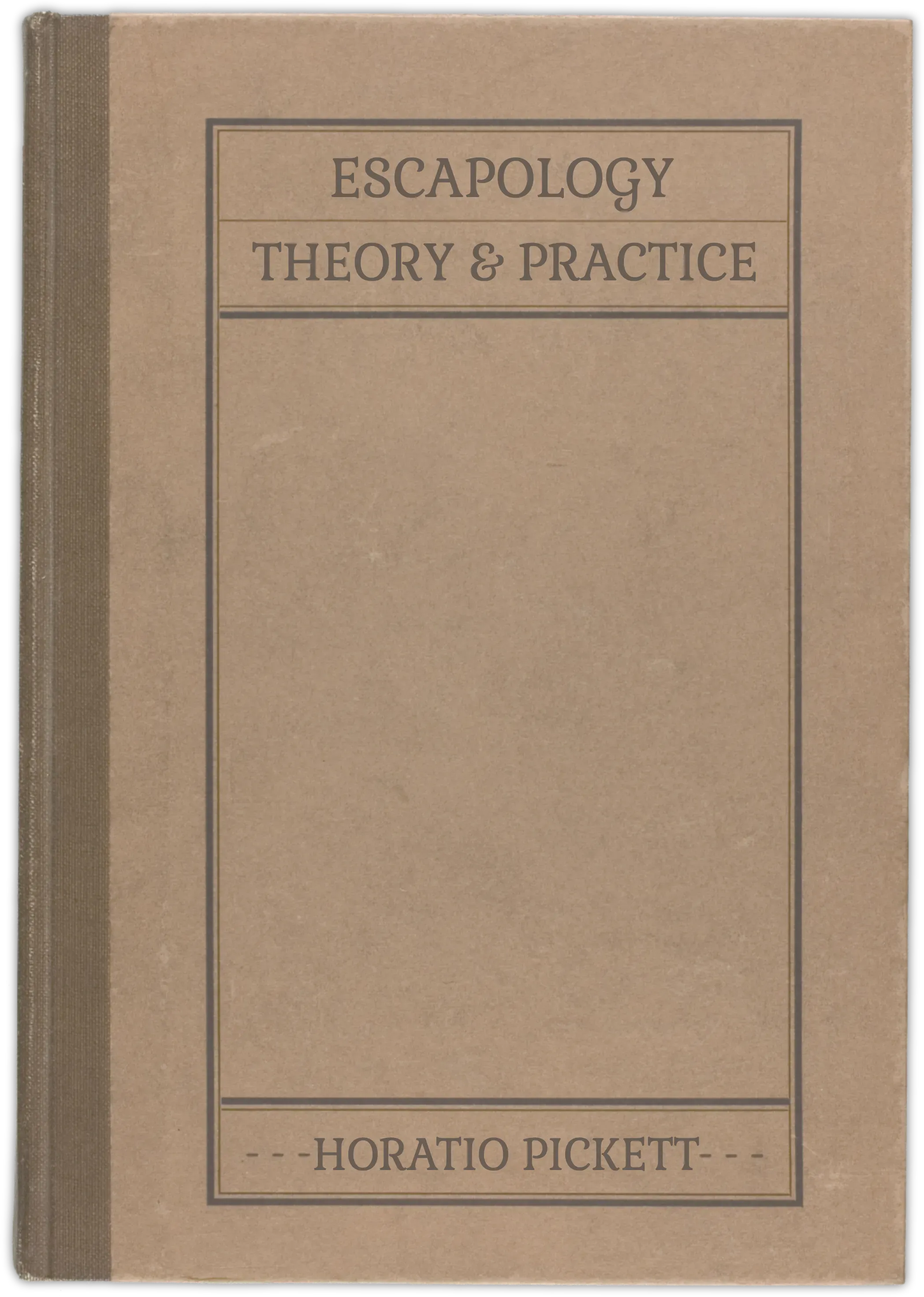
- A textbook called Escapology: Theory and Practice by Horatio Pickett. The book is open to a section with step-by-step instructions for escaping a straitjacket.
Den
The den has gold Art Deco wallpaper and a marble fireplace. There are several built-in bookcases in the walls, although the shelves are empty. A few couches and comfortable, overstuffed chairs are arranged around the room. The place looks conspicuously barren.
A successful Spot Hidden check uncovers $0.19 in loose coins in the couch cushions and a crystal snifter under the easy chair.
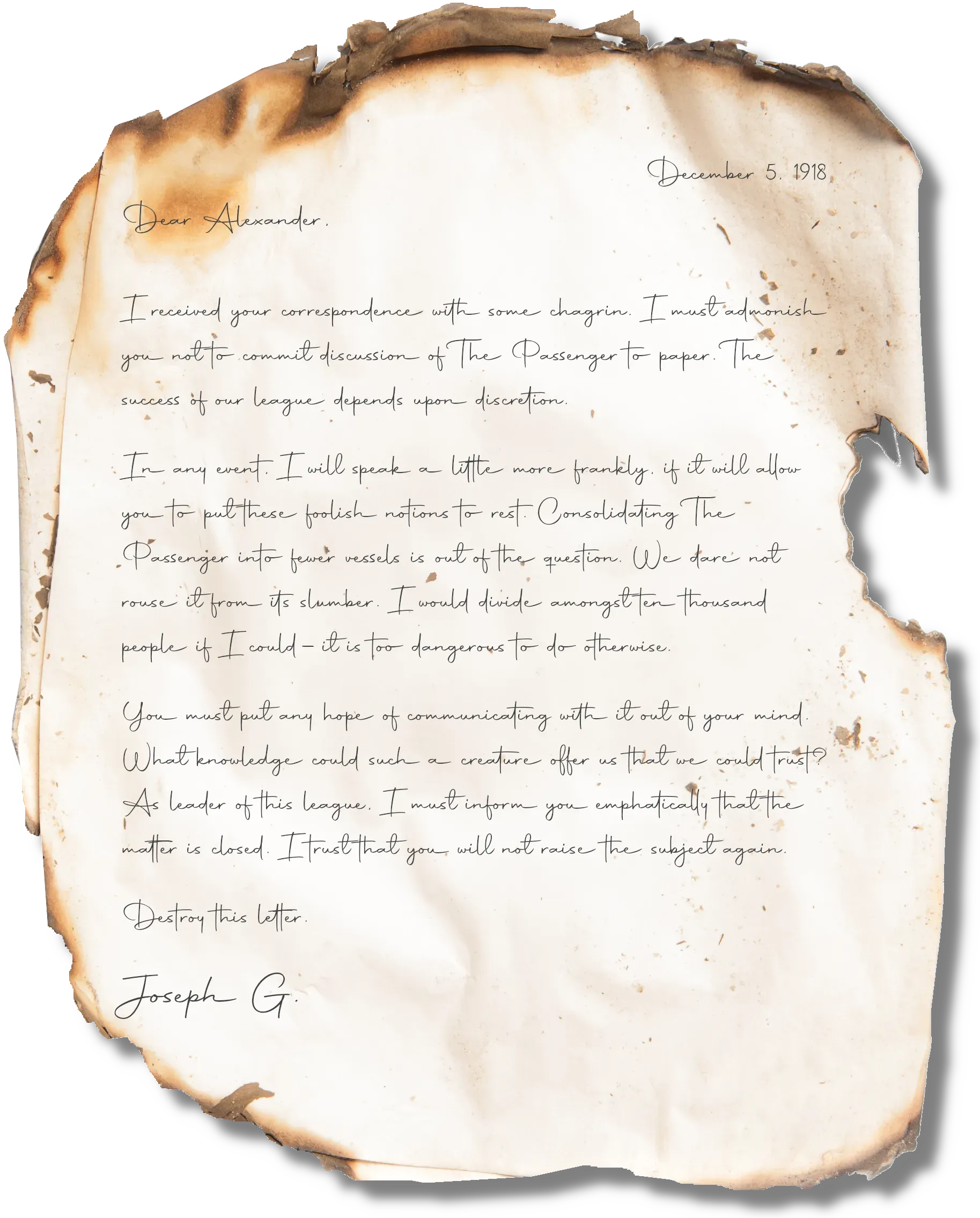
Charlotte also discovers a charred letter in the fireplace, half-buried in the ash. This is a letter from “Joseph G”
Leaving Imhoff’s House
As the investigators try to slide out of the house without being noticed, the nosy neighbour sees them and threatens he will call the buttons”, they better “chase themselves”.
Frank approaches the old man and by succeeding an intimidate roll he manages to make his “piss his pants” and go back in his house.
The investigators then leave and go to Boston Globe to meet Lucy & Dr. Sharpe.